Showing posts with label Qualifier. Show all posts

Tuesday, 16 April 2024

David Rose On Qualifiers

Qualifiers specify a Thing, so the semantic probe (from ‘above’) is which or whose Thing?
Which year?
The year [1920]

Which city?
The city [of Rome]
and again at 12:45:
Focus attends to some aspect of the Thing – a facet, part, class or group. The Thing doesn't specify the Focus. Focus is realised by an embedded nom gp, usually linked to the nom gp by the structure marker ‘of’.

[green leaves of] the trees, [some historic buildings of] Rome

Qualifier is realised by an embedded clause or prep phrase

In The city [of Rome], ‘of’ is a preposition, specifying which city.

Blogger Comments:


[1] To be clear, the Deictic, Numerative, Epithet, Classifier all serve to characterise the Thing (Halliday & Matthiessen 2014: 382), so the probe 'Which Thing?' does not uniquely identify a Qualifier. For example,

  • which year? this year: Deictic
  • which year? the third year: Numerative
  • which year? a good year: Epithet
  • which year? a leap year: Classifier
Likewise

  • which city? her city: Deictic
  • which city? the next city: Numerative
  • which city? a polluted city: Epithet
  • which city? the eternal city: Classifier

[2] To be clear, 'Focus' is Martin's use of a textual concept to rebrand embedded experiential elements preceding the Thing in a nominal group.

[3] This should go without saying, since it is the Thing that is characterised in a nominal group.

[4] To be clear, these are simply nominal groups with Qualifiers:
  • green leaves [of the trees]
  • some historic buildings [of Rome]
[of the trees] qualifies leaves in terms of type, [of Rome] qualifies buildings in terms of location.

[5] Trivially, Qualifier is also realised by an embedded adverbial group, as in
  • some 4,000 million years [ago]

[6] Clearly, the structure-marking preposition of does not specify which city:
  • which city? of.

Saturday, 24 February 2024

David Rose On 'The Days Of Auld Lang Syne'

David Rose replied to Rosemary Huisman on asflanet on 22 Feb 2024, 20:32:
So the actual structure is a nom gp
the days of auld lang syne
The Scottish National Dictionary gives multiple glosses for syne, including ‘ago’. In which case it’s an ellipsed embedded clause
the days [of old] [[long ago]]
(Qualifier probes are which days? and which days of old?)


Blogger Comments:

To be clear, Rose provides constituency and two functions, but no structural analysis. Returning to the original Scots wording, and applying the standard model of SFL Theory, lang syne is an adverbial group that elaborates the prepositional phrase of auld in a paratactic complex that serves as the Qualifier of days:


Both units of the Qualifier realise the meaning 'in the past', with the second elaborating the first, and the relation is paratactic, because neither depends on the other:
The days of auld (old)
The days lang syne (long ago)

However, on the model of Halliday (1994: 193):


 the logical structure is:

Friday, 23 February 2024

David Rose On 'Ago' And Premodified And Postmodified Adverbial Groups

By ‘surface syntax’ do you mean the syntagm face of our structure-&-syntagm (function-&-class) pairings? If so, Qualifier is realised by an embedded clause or prep phrase, which excludes adverbs like ago. From above, the Qualifier function defines its Thing, probed by which (Thing)?, which also excludes adverbs like ago. This was Pin’s point, not subjectively perceived, but a consistently recurring functional criterion. I think you’re right that we need to be ‘strictly consistent about doubled-up Function-and-Class labelling’

For interest here’s another adv gp analysed in this way... 


IFG also discusses a type of comparative adv gp, that is post-modified with an embedded clause or phrase. It is isn’t named but I’ve used ‘esphoric’ here by analogy with esphoric reference in nom gps, like the children [in blue hats]


Blogger Comments:

[1] This is misleading, because it is untrue. In the nominal group some 4,600 million years ago, the Thing years is characterised by the embedded adverbial group ago. The fact that ago can be premodified demonstrates that ago is the Head of an adverbial group.

[2] This is misleading, because it is untrue. In the nominal group some 4,600 million years ago, the Thing years is characterised by the embedded adverbial group ago rather than the embedded adverbial group hence; that is, the Thing is characterised as 'in the past' rather than 'in the future'. See the examination of Pin Wang's argument here.

[3] This is true.

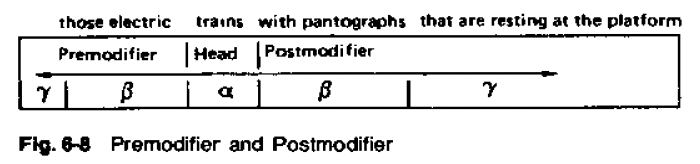
[4] To be clear, on the model of Halliday (1994), there is no submodification in this adverbial group. So:


That is, Rose proposes internal bracketing, or nesting, where there is none, giving the analysis:
α(β(βα)α)β 
which can be expanded as 
αββ ^ αβα ^ αα ^ β
Rose then compounds the error by misinterpreting the nesting as the double embedding of adverbial groups within the adverbial group, without realising that they must be embedded on this analysis. And, again, on the belief that the adverbial groups are not embedded, incongruously proposes 2-unit complexes (duplexes) consisting of units of different ranks: group and word.

[5] To be clear, 'esphora' is Martin's (1992: 123) rebranding of Halliday & Hasan's (1976) structural cataphora. See The Inconsistencies Created By Rebranding Structural Cataphora As Esphora.

[6] To be clear, on the model of Halliday (1994), there is no submodification in this adverbial group. So:


That is, Rose proposes internal bracketing, or nesting, where there is none, and includes the Postmodifier in the dependency relations, giving the analysis:
β(β(βα)α)α 
which can be expanded as 
βββ ^ ββα ^ βαβ ^ βαα ^ α
Rose again compounds the error by misinterpreting the nesting as the triple embedding of adverbial groups within the adverbial group, without realising that they must be embedded on this analysis. And, again, on the belief that the adverbial groups are not embedded, incongruously proposes 2-unit complexes (duplexes) consisting of units of different ranks: group and word.

And, even in terms of his own approach, Rose has neglected to analyse his final adverbial group so much as the subjacency duplex #βα.

Monday, 6 November 2017

David Banks' Reasons For Not Identifying 'Accompaniment'

 David Banks replied regarding Annabelle Lukin's query on sysfling on 2 November 2017 at 22:09:
It seems to me that if you say "between Iraqi and British forces" is a circumstance, that means that it is functioning at the level of the clause, and it is a circumstance of the predicator "have been". But I don't feel that holds water. If "between Iraqi and British forces" is related to a process, then that process is "clashes", which is a nominalized process, and the relationship is not circumstantial but agentive, so in the unpacked variant "Iraqi and British forces clashed", "Iraqi and British forces" functions as actor. This is not unusual; it is common in cases of grammatical metaphor, for the putative actor of a nominalized process to be encoded in a prepositional phrase functioning as qualifier of the nominalized process. It is the reciprocal nature of the process in this case that gives us the process "between" rather than "by".

If we simply ask: what is "between Iraqi and British forces" doing, surely the answer is: telling us about the nature of "clashes", that is, it is describing "clashes". Since "clashes" is a noun, an element which describes it is a modifier or qualifier. 
The only complication arises because "clashes" is a nominalized process. Who is doing the "clashing": answer: "Iraqi and British forces". So the qualifier encodes the putative actor of the nominalized process.

and on 3 November 2017 at 19:22:
Among the numerous variants we have:
"Iraqi forces clashed with British forces"
"British forces clashed with iraqi forces"
"Iraqi and British forces clashed"
So, I feel, you can't get away from the fact that "Iraqi forces" and "British forces" are the participants in the process of "clashing", and the grammatical metaphor (used for reasons we do not know since it's out of context) means that the participants are encoded as a qualifier of the nominalized process.

I agree with almost everything David wrote, with the possible exception of needing to agree to disagree! :-)


Blogger Comments:

Reminder: the clause under discussion is
there have been more clashes between Iraqi and British forces.

[1] Trivially, a circumstance is attendant on a Process (experiential), not a Predicator (interpersonal), and have is Finite and been is Predicator.

[2] This is incorrect.  The Process of this clause is have been, not clashes; clashes functions as the Thing/Head of the nominal group more clashes which functions as the participant Existent.

[3] This is true; clashes is a nominalised process, which is why it doesn't function as the Process of this metaphorical clause.  It is in the more congruent agnates, which Banks cites, that it functions as Process.

[4] The agency of both the metaphorical clause and its congruent agnates is 'middle', not 'effective';  that is, there is no Agent.

[5] This part is true, but irrelevant, because the query is about the metaphorical clause, not its more congruent agnates.

[6] An instance of this type would be there have been more attacks by British and Iraqi forces.  In this type, the prepositional phrase is indeed functioning as Qualifier, since, unlike the clause under discussion, it can't be thematised without more attacks; see previous post on determining constituency.

[7] Here Banks repeats Bartlett's misinterpretation of 'joint participation in the process' as 'reciprocality'; see previous post.  Since the process is not 'reciprocal' — the British and Iraqi forces didn't "clash each other" — this is not the reason for the minor Process being between rather than by.  The function of between is to construe the joint participants as a circumstance; see [8].

[8] The prepositional phrase metaphorically construes the joint participants in what is congruently a material Process, 'clash', as circumstantial to the existential Process have been.  The type of circumstance that construes joint participation is 'Accompaniment' (Halliday & Matthiessen 1999: 174; Halliday & Matthiessen 2014: 324).

[9] This correctly identifies agnates of the metaphorical clause, demonstrating both Accompaniment (with British forces, with Iraqi forces) and its relation to 'joint participation' (Iraqi and British forces), but still fails to make the theoretical connection.

[10] What we can say is that the grammatical metaphor reconstrues a very material process as one of merely existing, and reconstrues the participants of that Process, both Agent and Medium, as merely circumstantial.  Given that it was Britain that illegally invaded Iraq, and not the contrary, we can take a wild stab in the dark and suggest that one reason the metaphor was used was to hide the agency of British humans in the "clash", along with the fact that their actions impacted on Iraqi humans.

[11] See [1] to [10] above.  See also Thoughts That Didn't Occur…