Showing posts with label Adverbial Group. Show all posts

Sunday, 21 April 2024

David Rose On Adverbial Group Agnation

David Rose wrote to asflanet on 16 Apr 2024, 20:00:
agnation for the consumer


... as subtypes of intensification

The nominal realisation is downranked and metaphorical (as with [in the past]). Like congruent adverbial realisations, it can be further intensified and combine with polarity and comparison (but not identically).


Blogger Comments:

[1] To be clear, this is part of Rose's argument that 4.5 billion years ago is an adverbial group. Here he claims that it is agnate with the adverbial group long ago, in that the two are related through the adverbial group system of intensification. There are two problems with this claim.

First, intensification is not a system of the adverbial group, so the two variants are not systemically related through intensification. Instead, 'intensification' describes a type of adverb serving as a Premodifier. Clearly, an embedded nominal group is not a type of adverb. Halliday & Matthiessen (2014: 420-1):
The items serving as Premodifiers are adverbs belonging to one of three types – polarity (not), comparison (more, less; as, so) and intensification. … Those of intensification indicate higher or lower intensity; they are either general intensifiers that are interpersonally neutral (very, much, quite, really, completely, totally, utterly; rather, fairly, pretty; almost, nearly), including the interrogative adverb how, or specific ones that derive from some interpersonally significant scale (amazingly, astonishingly, awfully, desperately, eminently, extraordinarily, horribly, incredibly, perfectly, terribly, terrifically, unbelievably, wonderfully).
Second, if the nominal group 4.5 billion years is interpreted as premodifying ago, then it specifies the temporal extent of ago, not its intensification.

Instead, 4.5 billion years [ago] is a nominal group that is agnate with the nominal group 4.5 billion years [in the past], since they differ only in how a feature of the QUALIFICATION system is realised: as an embedded adverbial group (ago) or an embedded prepositional phrase (in the past). Matthiessen (1995: 669):

On the basis of Matthiessen's network, the feature they both realise is enhancing qualification: time: past.

[2] To be clear, in the case of the two nominal groups, 4.5 billion km away and 4.5 billion years ago, the Qualifiers away and ago are embedded adverbial groups, not ranking adverbs (as Rose would have it). This can be shown by the potential for modification:
  • 4.5 billion km further away [than that]
  • 4.5 billion years longer ago [than that]

[3] As demonstrated above, it is the adverbial group ago that downranked like the prepositional phrase in the past, not 4.5 billion years.

[4] To be clear, this potential is available to nominal groups:

not so very many years [as that]

Saturday, 24 February 2024

David Rose On 'The Days Of Auld Lang Syne'

David Rose replied to Rosemary Huisman on asflanet on 22 Feb 2024, 20:32:
So the actual structure is a nom gp
the days of auld lang syne
The Scottish National Dictionary gives multiple glosses for syne, including ‘ago’. In which case it’s an ellipsed embedded clause
the days [of old] [[long ago]]
(Qualifier probes are which days? and which days of old?)


Blogger Comments:

To be clear, Rose provides constituency and two functions, but no structural analysis. Returning to the original Scots wording, and applying the standard model of SFL Theory, lang syne is an adverbial group that elaborates the prepositional phrase of auld in a paratactic complex that serves as the Qualifier of days:


Both units of the Qualifier realise the meaning 'in the past', with the second elaborating the first, and the relation is paratactic, because neither depends on the other:
The days of auld (old)
The days lang syne (long ago)

However, on the model of Halliday (1994: 193):


 the logical structure is:

Friday, 23 February 2024

David Rose On 'Ago' And Premodified And Postmodified Adverbial Groups

By ‘surface syntax’ do you mean the syntagm face of our structure-&-syntagm (function-&-class) pairings? If so, Qualifier is realised by an embedded clause or prep phrase, which excludes adverbs like ago. From above, the Qualifier function defines its Thing, probed by which (Thing)?, which also excludes adverbs like ago. This was Pin’s point, not subjectively perceived, but a consistently recurring functional criterion. I think you’re right that we need to be ‘strictly consistent about doubled-up Function-and-Class labelling’

For interest here’s another adv gp analysed in this way... 


IFG also discusses a type of comparative adv gp, that is post-modified with an embedded clause or phrase. It is isn’t named but I’ve used ‘esphoric’ here by analogy with esphoric reference in nom gps, like the children [in blue hats]


Blogger Comments:

[1] This is misleading, because it is untrue. In the nominal group some 4,600 million years ago, the Thing years is characterised by the embedded adverbial group ago. The fact that ago can be premodified demonstrates that ago is the Head of an adverbial group.

[2] This is misleading, because it is untrue. In the nominal group some 4,600 million years ago, the Thing years is characterised by the embedded adverbial group ago rather than the embedded adverbial group hence; that is, the Thing is characterised as 'in the past' rather than 'in the future'. See the examination of Pin Wang's argument here.

[3] This is true.

[4] To be clear, on the model of Halliday (1994), there is no submodification in this adverbial group. So:


That is, Rose proposes internal bracketing, or nesting, where there is none, giving the analysis:
α(β(βα)α)β 
which can be expanded as 
αββ ^ αβα ^ αα ^ β
Rose then compounds the error by misinterpreting the nesting as the double embedding of adverbial groups within the adverbial group, without realising that they must be embedded on this analysis. And, again, on the belief that the adverbial groups are not embedded, incongruously proposes 2-unit complexes (duplexes) consisting of units of different ranks: group and word.

[5] To be clear, 'esphora' is Martin's (1992: 123) rebranding of Halliday & Hasan's (1976) structural cataphora. See The Inconsistencies Created By Rebranding Structural Cataphora As Esphora.

[6] To be clear, on the model of Halliday (1994), there is no submodification in this adverbial group. So:


That is, Rose proposes internal bracketing, or nesting, where there is none, and includes the Postmodifier in the dependency relations, giving the analysis:
β(β(βα)α)α 
which can be expanded as 
βββ ^ ββα ^ βαβ ^ βαα ^ α
Rose again compounds the error by misinterpreting the nesting as the triple embedding of adverbial groups within the adverbial group, without realising that they must be embedded on this analysis. And, again, on the belief that the adverbial groups are not embedded, incongruously proposes 2-unit complexes (duplexes) consisting of units of different ranks: group and word.

And, even in terms of his own approach, Rose has neglected to analyse his final adverbial group so much as the subjacency duplex #βα.

Thursday, 22 February 2024

David Rose Adding Classes To His Analysis Of An Adverbial Group

David Rose wrote to asflanet on 20 Feb 2024, at 20:30:

Adding classes doesn't tell us much more about this adv gp


Blogger Comments:

[1] To be clear, for Halliday (1994: 210), there is no submodification in this adverbial group:
So

As can be seen, the dependency relations all obtain between words.

[2] To be clear, Rose proposes internal bracketing, or nesting, where there is none, giving the analysis:
β(β(β(βα)α)α)α 
which can be expanded as 
ββββ ^ βββα ^ ββαβ ^ ββαα ^ α
Rose then compounds the error by misinterpreting the nesting as the triple embedding of adverbial groups within the adverbial group, without realising that they must be embedded on this analysis. And, on the belief that the adverbial groups are not embedded, incongruously proposes 2-unit complexes (duplexes) consisting of units of different ranks: group and word.

Saturday, 17 February 2024

David Rose On Layers Of Subjacency

David Rose wrote to asflanet on 11 Feb 2024, at 15:08: 

In IFG there’s an analysis of adv gp as recursive hypotaxis... 

Image


This misses the interplay of comparison, intensification and negation in this adv gp. e.g. intensification ‘very much’; comparison ‘not so very much’. Here as layers of subjacency... 

not

so

very

much

more

easily

b comp


a

b intens


a


b comp


a


b neg

a

b intens

a


Here again with formal function labels. Each function is realised by a subjacency duplex, i.e. by the a b relation. 

not

so

very

much

more

easily

Comparison


b


a

Degree


b


a


Comparison


b

a


Negation

Degree


b

a

b

a


Blogger Comments:

[1] To be clear, here Rose simply rebrands logical structure as 'subjacency duplex'. More importantly, none of these satisfy its defining criterion of not being modifiable more than once.

[2] To be clear, as Halliday's analysis makes clear, there is only one level of modification in this adverbial group; that is, there is no internal bracketing. Moving from right to left in the structure simply involves increasing subcategorisation (Halliday & Matthiessen 2014: 389). So

How easily? more easily [comparison]
How more easily? much more easily [intensification]
How much more easily? very much more easily [intensification]
How very much more easily? so very much more easily [comparison]
How so very much more easily? not so very much more easily [negation]

Friday, 16 February 2024

David Rose On Subjacency Duplexes

Chris’ example is a nom gp, with embedded adv gp as Qualifier... 

some

of

those

days

[long

ago]

Focus


Deictic

Thing

Qualifier


a

b

determiner

noun

adv gp


b

a 

Here [long ago] specifies which days


Focus in English is realised by a subjacency duplex with the structure marker ‘of’, discussed in Martin & Doran 2023. The Head is more often an embedded nominal group... 

[a example]

of

those

days

[[a little while]

ago]

Focus


Deictic

Thing

Qualifier


a

b

demon

noun

adv gp


nom gp


b

a


nom gp


Martin, J. R., & Doran, Y. J. (2023, May). Structure markers: A subjacency duplex analysis. In Language, Context and Text. The Social Semiotics Forum (Vol. 5, No. 1, pp. 16-48


Blogger Comments:

[1] To be clear, in this case, Martin's 'Focus' is a rebranding of Halliday's Pre-Deictic (e.g. Halliday & Matthiessen 2014: 394).

In SFL Theory, a duplex is a complex of two units related by expansion or projection, where each unit in the complex serves the same function. This is not the case here. On the one hand, the preposition of does not modify the determiner some by expansion or projection, and on the other hand, the determiner some and the preposition of do not serve the same function. While the determiner some serves as a structural element, the preposition of does not. Instead, it functions as a structure marker. Halliday & Matthiessen (2014: 425):

The exception is prepositional phrases with of, which normally occur only as Postmodifier; the reason is that they are not typical prepositional phrases, because in most of its contexts of use of is functioning not as minor Process/Predicator but rather as a structure marker in the nominal group.

[2] For a close examination of Martin & Doran (2023), see the review here. Among other things, the authors mistake functions for structures, and so, mistake function markers for structure markers, with the result that most of the paper is concerned with adpositions that serve as function markers, rather than the structure markers they intended to provide a subjacency analysis for. 

[3] To be clear, on the basis of IFG (Halliday ± Matthiessen 1985, 1994, 2004, 2014), this can be analysed as follows:

(a) ranking nominal group:

(b) nominal group embedded in ranking nominal group:

(c) nominal group embedded in nominal group embedded in ranking nominal group:

That is, example of is not a two-unit complex (duplex) realising Focus, and a little while ago is a nominal group realising a Qualifier, not an adverbial group realised by a two-unit complex (duplex).

Wednesday, 14 February 2024

David Rose Misconstruing Nominal Groups, A Subjacency Duplex, And 'Instantiate'

David Rose wrote to asflanet on 11 Feb 2024, at 15:08:

Subjacency duplexes are dependency structures that are not recursive (not hypotactic series)


Proportionality first...

some days ago : some of those days long ago ::

adv gp : nom gp 

Also...

a little while ago : an example of those days a little while ago ::

adv gp : nom gp


Adverbial group structure is Modifier^Head 

long

ago

b

a 

This is a subjacency duplex with adverb as Head. (Ago can only instantiate the Head.)


The Modifier can be an embedded nom gp 

[a little while]

ago

b

a

nom gp


Here [a little while] specifies how long ago.


 Blogger Comments:

[1] To be clear, in SFL Theory, these are nominal groups and cannot be adverbial groups (see [4]).


[2] To be clear, even if subjacency duplex were a valid type of structure, this does not satisfy its condition of not being expandable beyond a single modifier, e.g. not so very long ago. In SFL terms, this is simply an adverbial group 'with adverb as Head'. 

[3] This seriously misunderstands 'instantiate'. Instantiation is the relation between potential and instance. The relation here is between a word and its function as Head at group rank, which is realisation.

[4] To be clear, in SFL Theory, the Premodifier of an adverbial group cannot be an embedded nominal group because it is inconsistent with the characterisation of an adverbial group having no lexical premodification. Halliday & Matthiessen (2014: 419-20):

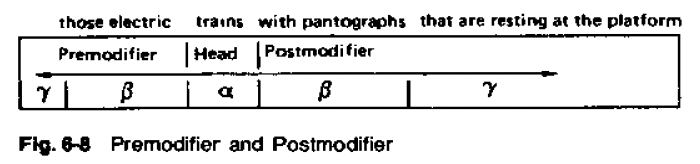
The adverbial group has an adverb as Head, which may or may not be accompanied by modifying elements. … Premodifiers are grammatical items like not and rather and so; there is no lexical premodification in the adverbial group. … The items serving as Premodifiers are adverbs belonging to one of three types – polarity (not), comparison (more, less; as, so) and intensification.

Friday, 9 February 2024

Pin Wang's Argument For A Nominal Group Being Adverbial

Pin Wang wrote to asflanet on 7 Feb 2024, at 21:20:
I agree with David on this one. From above, a Qualifier serves to identify an entity, answering which Thing is being talked about.

E.g.
- Which children?
- The children [in blue hats].

But not:
- Which years?
- Some 4,600 years [ago].

So not a nominal group, but an adverbial group. 


Blogger Comments:

[1] To be clear, socially, this is one member of Martin's community supporting another.

[2] To be clear, a Qualifier serves to characterise, not identify. Its function is experiential, not textual. Halliday & Matthiessen (2014: 382):

… the Qualifier also has the function of characterising the Thing; and again the Deictic the serves to signal that the characteristic in question is defining.

[3] To be clear, viewed 'from above', the meaning that the embedded adverbial group ago expresses is 'time: past'. In this nominal group, it characterises the Thing years as 'in the past', as opposed to 'in the future', the latter expressed by the nominal group some 4,600 years hence.

Which children? children in blue hats
Which years? years ago.

[4] To be clear, on all the evidence, this is simply a nominal group. But more to the point, it cannot be an adverbial group, because its premodification is not limited to grammatical items expressing polarity, comparison and intensification. Halliday & Matthiessen (2014: 419-22):

The adverbial group has an adverb as Head, which may or may not be accompanied by modifying elements. … Premodifiers are grammatical items like not and rather and so; there is no lexical premodification in the adverbial group. … The items serving as Premodifiers are adverbs belonging to one of three types – polarity (not), comparison (more, less; as, so) and intensification.

Thursday, 8 February 2024

David Rose's Argument For A Nominal Group Being Adverbial

David Rose wrote to asflanet on 7 Feb 2024, at 19:20:

You can still hear MAKH’s 1985 IFG wording here (emphases his)...
6.2.2.2 Qualifier
What of the element which follows the Thing? The original example, Look at those two splendid old electric trains with pantographs, ended with the phrase with pantographs; this also is part of the nominal group, having a function we shall refer to as Qualifier.
Unlike the elements that precede the Thing, which are words (or sometimes word complexes, like two hundred, very big; see Section 6.3.2), what follows the Thing is either
a phrase or a clause.
... With only rare exceptions, all Qualifiers are rankshifted.
... Like the other, ‘ranking’ (i.e. non-embedded) elements of the nominal group, the Qualifier also has the function of characterising the Thing; and again the Deictic the serves to signal that the characteristic in question is defining.
In some 4,600 years ago, it’s not the adverb ago that is rankshifted, but the nominal group some 4,600 years. The adverb ago doesn’t ‘characterise’ or define the Thing years. Rather some 4,600 years specifies ‘how long ago’.

This is brought out by proportionalities like...
how long ago : how far away ::
very long ago : so far away ::
some 4,600 years ago : about 4,600 miles away


Blogger Comments:

[1] To be clear, there are many common examples of Qualifiers that are not rankshifted. For example:
  • the shortest distance possible
  • the most ludicrous hypothesis imaginable
  • the time available
  • the truth unvarnished
  • a people abandoned
  • life everlasting
  • something unexpected
  • anything unusual
In any case, the adverbial group ago is rank-shifted, to the rank of word, since it serves as an element of nominal group structure.

[2] To be clear, 4,600 years is not rankshifted. The adverbial group ago serves as Qualifier in the nominal group because it characterises the Thing years as 'time: past', in contradistinction to the adverbial group hence, which would characterise the Thing years as 'time: future'.

On the other hand, unlike the constituents of a genuine adverbial group, the words 4,600 years are not adverbs of polarity, comparison or intensification that serve as premodifiers of ago. Halliday & Matthiessen (2014: 419-22) explain:
The adverbial group has an adverb as Head, which may or may not be accompanied by modifying elements. … Premodifiers are grammatical items like not and rather and so; there is no lexical premodification in the adverbial group. … The items serving as Premodifiers are adverbs belonging to one of three types – polarity (not), comparison (more, less; as, so) and intensification.

[3]  To be clear, the first two lines satisfy the conditions of being adverbial groups, since each features an adverb as Head premodified by adverbs of intensification. The last line, however, does not satisfy these conditions, and simply shows nominal groups with a temporal Qualifier, as previously explained. A single form, ago or away, is insufficient evidence of a common function structure. A structure is the relation among functional elements.