Showing posts with label Epistemology. Show all posts

Monday, 1 April 2024

David Rose On Institutional Marginalisation And Comparing Theories

 After ChRIS CLÉiRIGh replied to David Rose on asflanet on 25 Mar 2024, at 15:34:

So when it comes down to choosing between theories, say, Newton's or Einstein's construal of gravity, it comes down to feelings: which one the community feels happier with. Perhaps a more appropriate example would be a fundamentalist religious community choosing between Natural Selection and Creationism, on the basis of which one they feel happier with.


An example closer to home might be the persistent marginalisation of SFL in international linguistics. The people ignoring or locking it out of courses and departments all have PhDs in linguistic reasoning.

Couldn’t resist sharing this re comparing theories...
‘There is a distinct difference between having an open mind and having a hole in your head from which your brain leaks out’.


Blogger Comments:

[1] To be clear, here Rose is invoking the siege mentality of his faith community. From The Culture Of Strong Social Cohesion In The SFL Community at What Lies Beneath:

The origin of strong social bonds within the SFL community can be traced back to the early general exclusion of SFL Theory from linguistic departments and linguistic publications, due to the once overwhelming popularity of Chomskyan Formal Linguistics.


This strong sense of social cohesion has remained ever since, despite SFL Theory becoming less excluded from linguistic departments and linguistic publications.

From The Tactics Of The Disciplinarian Head Of The Martin Faith Fellowship at What Lies Beneath:

The way Martin constructs a socially bonded community around him is to invoke a 'siege mentality', both with regard to the SFL community in relation to the rest of the linguistic community, and with regard to his own community in relation to the rest of the SFL community.

[2] To be clear, this implies that SFL academics, unlike other linguists, do not have PhDs in linguistic reasoning. 

[3] To be clear, here Rose unwittingly presents a 2005 quote from the opponent of pseudoscience, the late James Randi, as if it supports Rose's anti-intellectualism rather than condemns it. The same point had been made previously by his friend, Richard Dawkins, in a public lecture in 1996:

By all means let's be open-minded, but not so open-minded that our brains drop out

and similar wordings have been attributed to Carl Sagan and Groucho Marx.

Sunday, 31 March 2024

David Rose On Feelings As The Basis Of Choosing Between Theories

So theorising is more about affiliation; less about relative explanatory potential and valid reasoning, and more about being bound together as a community by the interpretations of the theory produced by the community. And these interpretations serve as icons that the community can rally around and should celebrate.

David Rose replied on asflanet on 25 Mar 2024, at 14:31:

I don't believe those theoretical ideals can be excised from the embodied consciousness that produces them, as Edelman teaches us and you wrote about so brilliantly all those years ago, in terms of homeostasis. No matter how loftily we ideationalise our criteria for validity, it still comes down to feelings. Perhaps the loftier the criteria, the more feelings we invest.


Blogger Comments:

[1] To be be clear, the false assumption here is that assessing the explanatory potential and validity of theories would require excising them from consciousness, whereas it is consciousness that interpersonally enacts the propositions of theory, and consciousness that interpersonally assesses them for explanatory potential and validity.

[2] To be clear, for Rose, choosing between theories, say, Newton's or Einstein's construal of gravity, comes down to feelings: which one the community feels happier with, without regard for explanatory potential or validity. This is analogous to a fundamentalist religious community preferring Creationism to Natural Selection because they feel happier with it. Again, see The Culture Of 'Faith' In The SFL Community at What Lies Beneath

Saturday, 30 March 2024

David Rose On Interpreting, Extending And Enhancing Theory

Yes, the question’s not about grammar is it? It’s about metalanguage, so the explanation is necessarily at the stratum of register. And it’s not just a question about the theory, and its uses in analyses, applications, publishing and teaching, but about the community of users that we’re privileged to belong to. It’s about belonging and authority... who has the authority to interpret, extend or enhance the theory and its applications, whose analyses should be celebrated by the community, who’s inside. The simple answer is all of us. We all belong to the community, and we all draw our repertoires from its reservoir of appliable theory. We’re all guided by each other. The answers I’ve given are the best I can do, so thanks for asking the questions.
“Aunty,” Jem spoke up, “Atticus says you can choose your friends but you sho’ can’t choose your family, an’ they’re still kin to you no matter whether you acknowledge ’em or not, and it makes you look right silly when you don’t.”


Blogger Comments:

[1] To be clear, Rose had been asked about the explanatory advantage of one grammatical analysis over another. This he could not answer. 

[2] To be clear, for Rose, theorising is about belonging and authority. From The Culture Of 'Faith' In The SFL Community at What Lies Beneath:

Its intellectual challenges and contrary methodology make SFL Theory and its argumentation comparatively difficult to understand. This creates a culture in the SFL community where the theory is less understood than taken on trust, like religious faith.

In a faith community, a doctrine is held as a revelation to be believed, rather than a theory to be in/validated by reasoned argumentation. In such a community, experts are providers or interpreters of revelations, rather than experts in reasoned argumentation, and in matters of interpretation, it is such individuals that are criterial, rather than reasoned argumentation. With individuals as criterial in doctrine interpretation, communities form around those individuals.

[3] To be clear, for Rose, every member of the community has authority in matters of theory, interpretation and analysis. From The Promotion Of Anti-Intellectualism In The SFL Community at What Lies Beneath:

One consequence of not realising that Systemic Functional Linguistic Theory is a scientific theory is the belief that work in the theory does not have to be consistent with the theory. The extreme version of this is the belief that all theoretical opinions are valid, and this view is sometimes defended as open-minded fairness.

However, just as work in other scientific theories — such as Quantum Theory or the General Theory of Relativity — has to be consistent with a valid theory to be valid, so too does work in SFL Theory.

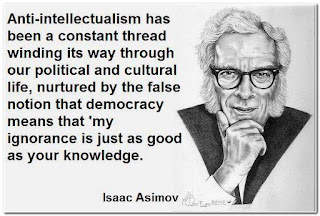
Isaac Asimov has explained this form of anti-intellectualism as a misapplication of the notion of 'democracy': 

Friday, 15 March 2024

David Kellogg On Logic And Tone

David Kellogg wrote to sys-func on 9 Mar 2024, at 08:19:
Not one of the responses has really taken up b), the argument which says that logic cannot be "applied" directly to scientific problems, because the level of organisation at which and the concepts and data to which the logic must be applied are radically different, so logic itself develops as we move from arithmetic to statistics, and still more as we move from math to physics to chemistry to biology to socio-psychology to semiotics.

Now, in itself, these data points suggest to me that...well, that we are human, and the "tone" in which something is said is not simply part of the grammar (Halliday and Greaves, 2009) but also part of our semantics and part of the context of situation Chris's attempt to imagine argumentation where tone is not an essential part of the argument is chimerical. …

Halliday would say it somewhat differently: he would say that "logical" arguments, and even my meta-logical argument, are just everyday language (i.e. my aggressively intoned argument) which has been "tidied up", and he would probably agree that tidying up "tone" is, in the long run, impossible for humans to do: it is literally like trying to speak without any intonation at all.


Blogger Comments:

[1] To be clear, logical validity is argument–internal, since it is concerned with premisses and the reasoning from premisses to conclusions. Logical validity, therefore, does not vary with the field in which it is applied.

[2] To be clear, logical validity is a means of distinguishing arguments that are valid from arguments that are fallacious. Applied to scientific problems, logical validity is a means of distinguishing scientific solutions that rest on arguments that are valid from scientific solutions that rest on arguments that are fallacious.

[3] To be clear, this confuses the phonological system of TONE with tone in the sense of 'tone policing'.

[4] This is misleading, because it is untrue. ChRIS — whose PhD thesis was on phonology — did not attempt to imagine argumentation without intonation. He simply informed the sys-func subscribers of the logical fallacy known as tone policing:

Tone policing – focusing on emotion behind (or resulting from) a message rather than the message itself as a discrediting tactic.

Sunday, 25 February 2024

David Rose On Theories, Communities And Academic Fields

Perhaps we need to consider theories in relation to the communities that affiliate around them. Academic fields are highly structured and metastable...until they aren’t.


Blogger Comments:

[1] To be clear, this sociological approach says nothing about the validity of a theory that communities "affiliate around", as demonstrated by the community that is bound together by the theory that the Earth is flat, or by the theory that Earth was created on October 22, 4004 BC. But such a sociological approach is nevertheless valuable, to the extent that it enables the comparison of what counts as evidence across different communities.

[2] This confuses field with community. Field is the ideational dimension of the culture as semiotic system, which includes theories, which is distinct from the social structure of a community.

Monday, 19 February 2024

David Rose On Theory As Theological

Theories are also constellations of icons that adherents affiliate around (thanks Michelle Z and Ken Tann). Basil Bernstein recognised the roots of secular theories in medieval theology, following Durkheim (‘the fundamental categories of science are of religious origin’, 1915:418) and Max Weber (the original ‘legitimation’ theorist). Here’s BB in 2000...
The religious field is constituted by three positions which stand in various relations of complementarity and opposition. In the religious field, we have the prophets, we have the priests, and we have the laity. The rule is that one can only occupy one category at a time. Priests cannot be prophets, and prophets cannot be priests, and the laity cannot be either. There is a natural affinity between prophets and laity, and there is a natural opposition between prophets and priests. These are the lines of opposition structuring the religious field.

If we look at the structure of the pedagogic field, we also have basically three positions that provide analogues to the prophets, priests and laity. The ‘prophets’ are the producers of the knowledge, the ‘priests’ are the recontextualisers or the reproducers, and the ‘laity’ are the acquirers. Thus, we have the structure of the pedagogic field.
Icons like immanence and transcendence are borrowed directly from theological beliefs about the relation of spirit to matter, for which adherents could be excommunicated or worse :-( Bateson’s metatheorising was explicitly theological, rebadging god as ‘mind’ which he believed was immanent in the ‘supreme cybernetic system’. In Lexie’s quote below, he is concerned with the theological question of ‘truth’.* In contrast, Lemke is more interested in the ‘usefulness’ of theories, or as MAKH would call it, ‘appliability’.

* Distinct from philosophical argumentation about truth value of propositions, which is closer to Chris’ yes/no questions of ‘validity’ here.


Blogger Comments:

[1] To be clear, this is sociology: a model of human behaviour. It doesn't distinguish theories (metaphenomena) from favourite football teams, favourite tennis players, favourite pop stars or favourite gurus (phenomena). Nor does it distinguish academics from sports fans, pop music fans or devotees of gurus. That is, it is a model of behaviour with no regard for the intellect and reasoning behind the behaviour.

[2] Synonyms of 'adherent' include:
follower, supporter, upholder, defender, advocate, disciple, votary, partisan, friend, member, stalwart, fanatic, zealot, believer, worshipper, attender, fan, admirer, enthusiast, devotee, lover, addict, aficionado, hanger-on, groupie, buff, freak, fiend, nut, maniac, booster, cohort, rooter, janissary, sectary

[3] To be clear, not theology and not mediæval. Not theology, because theology is the study of religious belief from a religious perspective. Not mediæval, because, as the comparative mythologist Joseph Campbell points out, science fulfils the cosmological function of mythology, and because mythology involves the use of lexical metaphor to reconstrue meaning construed of experience, this dates back to the beginning of metaphor which, according to Halliday was made possible by the stratification of the content plane, which he claims turned Homo … into Homo sapiens (Halliday & Matthiessen 2014: 25).

[4] To be clear, this a sociological model of the social structure of a pedagogic field. That is, it is a model of teachers and teaching, not of the semiotic process of theorising.

[5] To be clear, from an epistemological perspective, 'immanence' and 'transcendence' are orientations to meaning in Western thinking. Halliday & Matthiessen (1999: 415, 416):

We can identify two main traditions in Western thinking about meaning (see Halliday, 1977):
(i) one oriented towards logic and philosophy, with language seen as a system of rules;

(ii) one oriented towards rhetoric and ethnography, with language seen as resource. …
The two orientations towards meaning thus differ externally in what disciplines they recognise as models. These external differences are associated with internal differences as well.

(i) First, the orientations differ with respect to where they locate meaning in relation to the stratal interpretation of language:
(a) intra-stratal: meaning is seen as immanent — something that is constructed in, and so is part of, language itself. The immanent interpretation of meaning is characteristic of the rhetorical-ethnographic orientation, including our own approach.

(b) extra-stratal: meaning is seen as transcendent — something that lies outside the limits of language. The transcendent interpretation of meaning is characteristic of the logico-philosophical orientation.

[6] Rose's interpretation of Bateson is rejected by an expert on Bateson's work. See here. 

[7] To be clear, Ptolemy's Earth-centred model of the known Universe in terms of epicycles was appliable but invalid. Copernicus's Sun-centred model was less appliable, but more valid. Appliability is no guarantee of theoretical validity.

The astronomical predictions of Ptolemy's geocentric model, developed in the 2nd century CE, served as the basis for preparing astrological and astronomical charts for over 1,500 years. The geocentric model held sway into the early modern age, but from the late 16th century onward, it was gradually superseded by the heliocentric model of Copernicus (1473–1543), Galileo (1564–1642), and Kepler (1571–1630). There was much resistance to the transition between these two theories. Some felt that a new, unknown theory could not subvert an accepted consensus for geocentrism.

[8] This is very misleading indeed. On the one hand, the truth value of propositions is the concern of the logico-philosophical tradition, not the rhetorical-ethnographic tradition in which SFL is located. On the other hand, validity is not simply a question of whether propositions are true or false. Validity is a matter of whether conclusions follow from premises. For example,

Given these epistemological assumptions, is this theory valid?
Given this theoretical model, is this application of the theory valid? 

∞

See also The Culture Of 'Faith' In The SFL Community.

Sunday, 18 February 2024

David Rose On The Absence Of Published Criticism Of Each Other’s Work

David Rose wrote to asflanet on 14 Feb 2024, at 10:37:
An interesting feature of SFL, in contrast to some other linguistic schools, is an absence of published criticism of each other’s work. You can see this ethic of learning from each other and getting on with it continually in Halliday’s interviews. …

And again at 13:27:

The point is that linguistics sits in the humanities and has inherited its habits, especially philosophy’s notions of truth and falsehood. SFL’s approach to observing and theorising is closer to how science works.


Blogger Comments:

[1] This is misleading because it is untrue. Martin (1992) criticises Hasan's work on cohesion, Hasan (1995) criticises Martin's stratification of context, and Fawcett (2010) criticises Halliday's model of grammar, to name but three.

[2] To be clear, 'learning from each other and getting on with it', without critical assessment of each other's work, is an anti-intellectual approach that serves the interests of the incompetent, and not just fosters, but proliferates theoretical misunderstandings and poor quality work. See The Promotion Of Anti-Intellectualism In The SFL Community

[3] As Halliday has pointed out, we don't argue about truth, we argue about validity.
  • Are the assumptions on which this theory is founded valid?
  • Is this theoretical description valid?
  • Is this interpretation of theory valid?
[4] To be clear, SFL is a scientific theory, but the culture of much of the SFL community is more like that of a religious fellowship. See

The Scientific Status Of Systemic Functional Linguistic Theory
The Culture Of 'Faith' In The SFL Community

Monday, 4 December 2023

Ed McDonald On What SFL Should Be Working Towards

Edward McDonald wrote to sys-func on 27 Nov 2023, at 10:05:

So if I think we always need to look outside language in order to understand language … equally I think we need to look outside SFL in order to understand what we are doing within SFL. 
The days of the grand all-encompassing theory, the Theory of Everything which I note the physicists are still struggling towards, for me are well over, even if you put aside the historical accident that it was a man deeply UNinterested in language as she languages, i.e. Old Noam, who was responsible for the best known of such theories in our current academic ecology. 
How can one theory be social, cognitive, pure, applied, etc etc all at the same time? It seems to me that it would be far more helpful — not to mention more feasible — for (at least) two complementary theories that start out from completely different premises to somehow manage to meet in the middle, and that this is what those of us working within SFL should be working towards creating a space for, a space that needs to be both practical and intellectual, both ideational and interpersonal. …


Blogger Comments:

[1] To be clear, on the assumption of 'immanence', which informs SFL, there can be no final theory, because there is no meaning beyond semiotic systems that theories can finally equal. Instead, theories are evolving semiotic systems, and the open-ended process of evolution entails that there is no final state of such a system.

[2] To be clear, a theory of everything in physics would unify the General Theory of Relativity (modelling gravity) with Quantum Theory (modelling the other three forces). See Quantum Gravity Viewed Through Systemic Functional Linguistics.

[3] To be clear, these are not components of an 'all-encompassing' theory. 'Social' and 'cognitive' are different priorities in theorising, though not mutually exclusive, whereas 'pure' and 'applied' is the distinction between theorising and applying a theory to practical purposes.

[4] To be clear, after dismissing the pursuit of a theory of everything, as exemplified by physicists, here McDonald advocates that SFL should do precisely the sort of thing that physicists are trying to do: make two complementary theories, General Relativity and Quantum Mechanics, meet in the middle in a theory of quantum gravity.

Sunday, 3 December 2023

Ed McDonald On The Interpersonal Motivation Of Model Selection

Edward McDonald wrote to sys-func on 27 Nov 2023, at 10:05:

In this regard, members of this and other lists may have noticed that I seem to talk about my own experience a lot. But I hope they will also have noticed that I do so not to stress the particularity of my experience but rather its representativeness. I don't think my own experiences are special: I just think we're all far more affected by our own experience in the process of developing our academic thinking than we often like to admit. For example, in observing and reflecting on how people take up and adapt ideas of all kinds, including theories of language, I have become convinced that, whatever may be the purposes for which such ideas end up being used, the reasons for which they're taken up are far more likely to be interpersonal than ideational: because people you admire hold them, or because they're held by a group you want to join, or because they're being used for a practical/political/ideological project with which you're aligned.


Blogger Comments:

To be clear, this is indeed a very serious problem within the SFL community, given that SFL theory, as created by Halliday, is a scientific theory; see What Lies Beneath.

See also, from The Evolution Of Models on The Life Of Meaning:

Controlling Variation: Institutions As Model Reproduction Nurseries

Acting On Each Other: Modulation And Modalisation

Metafunctional Consistency And Selection

Ideational Consistency As Overtly Influencing The Probability Of Selection

Interpersonal And Textual Consistency As Covertly Influencing The Probability Of Selection

Social Immunological Systems

Communities As Bodies Organised By Shared Construals, Values And Attentions

Semiosis As Social Immunological Process

Tuesday, 28 November 2023

Ed McDonald On The Nature Of Semiosis

 Edward McDonald wrote to sys-func on 19 Nov 2023, at 14:02:

(3) … Can language be taken as the model / interpretant of all other semiotic systems …  

(McDonald 2013):
If social semiotic approaches are to free themselves from their current reliance on linguistic models, they will need to understand the nature of semiosis, in other words, to explicitly theorise the iconic and/or indexical and/or symbolic referential processes involved in recognising the links between expression and interpretation in the case of each modality, before they will be able to understand how modalities combine in ‘‘performance’’. Until we have, not a Semantics and the Body, to use the title of Ruthrof’s 1997 work, but a semantics of the body, the challenge of accounting for a multimodal text like opera in a semiotically democratic way will remain a question in search of an answer.

 
Blogger Comments:

[1] To be clear, the 'nature of semiosis' depends on the theory used to model it, which in turn, depends on the assumptions on which the theory is founded. The notion of a 'nature of a phenomenon' takes a transcendent view of meaning, which contradicts the the immanent view of meaning taken in SFL Theory. 

[2] To be clear, this confuses data with theory. Iconic and/or indexical and/or symbolic referential processes are not data to be theorised, but one way of theorising the data — that of Peirce. Moreover, Peirce's semiotics is inconsistent with SFL Theory in terms of the triadic sign relation, and in terms of icons, indexes and symbols referencing their objects (see here).

[3] To be clear, as previously demonstrated, McDonald first construed perceptible expression and interpretable behaviour as two poles of the context of a semiotic system, and then reconstrued these as the two poles of the semiotic system itself.

[4] To be clear, McDonald's notions of perceptible expression and interpretable behaviour construe the perspective of the listener only. The speaker and the musician — the performers — are excluded from this model of 'performance'.

[5] To be clear, the use of the word 'democratic' implies that other approaches are socially unjust, and that the approach McDonald advocates will right a wrong. As a logical fallacy, this might be termed an appeal to emotion.

Friday, 24 November 2023

Ed McDonald On The Need For A Triangulation Of Textual, Social And Theoretical


Firstly, a recommendation for a different kind of "trinocular" analysis of "texts" of all kinds from my paper in the Semiotic Margins collection: (1) The need for triangulation: textual, social, theoretical. McDonald (2011):
[I]t seems to me that what is needed for a social-semiotic treatment of any particular modality is a kind of triangulation between the analysis of its texts, the theoretical frameworks that have been applied to it, and the social meanings it has for its communities of users. It is not enough to have just one or two of these: 
the theoretical and social without the textual leaves the analysis ungrounded, with no way of understanding in detail how analysts have come up with their interpretations; 
the social and the textual without the theoretical traps analysts in the (unexamined) presuppositions of their commonsense (or ‘intuitive’) viewpoints; 
the textual and theoretical without the social makes analyses ultimately only personal ones – insightful, perhaps, but in the end only one individual interpretation.

Blogger Comments:

To clear, this is a non-issue in SFL Theory. A text is an instance of meaning, and the meaning of a social semiotic system is social in the sense that it is interpersonally exchanged in a community of users. Clearly, how a text is analysed depends fundamentally on the theory used to do so. Importantly, in the immanent view of meaning that SFL Theory takes, there is no ultimate theory of phenomena that can be reached by cherry-picking from different theories. Instead, there are applications of each theory that are either valid or invalid in terms of that theory.

Friday, 8 September 2023

David Rose Misunderstanding Immanence, Transcendence And 'Language Turned Back On Itself'

There’s more to Firth’s apparent disavowal than meets the eye. And times have changed. Here’s a prosaic gloss...
1 Our schematic constructs must be judged with reference to their combined tool power in a way our dealings with linguistic events in the social process.
‘Our metalanguage is designed for research’
2 Such constructs have no ontological status
‘Its terms shouldn't be mistaken for reality’
3 and we do not project them as having being or existence.
‘We don’t pretend they are’
4 They are neither immanent nor transcendent,
I dunno... hence my q to Ed
5 but just language turned back on itself.
‘but now I’m just going to bend your mind’.

and added at 19:53:

Please forgive me all, my ignorance

Immanence and transcendence were of course, not currents in lx theory, but in Christian theology, of the spirit located within or above the material world. But Firth’s readers would all have known that.


Blogger Comments:

[1] Again, Firth's first point is that theory must be judged according to its explanatory power in modelling language in context.

[2] To be clear, Firth's second and third points are that, in his view, the schematic constructs themselves have no ontological status: no being or existence.

[3] To be clear Firth's fourth point makes reference to opposing orientations to meaning in linguistic traditions, not Christian theology. Halliday & Matthiessen (1999: 415, 416):

We can identify two main traditions in Western thinking about meaning (see Halliday, 1977):
(i) one oriented towards logic and philosophy, with language seen as a system of rules;

(ii) one oriented towards rhetoric and ethnography, with language seen as resource. …
The two orientations towards meaning thus differ externally in what disciplines they recognise as models. These external differences are associated with internal differences as well.

(i) First, the orientations differ with respect to where they locate meaning in relation to the stratal interpretation of language:
(a) intra-stratal: meaning is seen as immanent — something that is constructed in, and so is part of, language itself. The immanent interpretation of meaning is characteristic of the rhetorical-ethnographic orientation, including our own approach.

(b) extra-stratal: meaning is seen as transcendent — something that lies outside the limits of language. The transcendent interpretation of meaning is characteristic of the logico-philosophical orientation.
Many traditional notions of meaning are of the second kind — meaning as reference, meaning as idea or concept, meaning as image. These notions have in common that they are 'external' conceptions of meaning; instead of accounting for meaning in terms of a stratum within language, they interpret it in terms of some system outside of language, either the 'real world' or another semiotic system such as that of imagery.
[4] Again, Firth's fifth point is simply that linguistic theory is the use of language to model language; linguistic theory is language about language: a metalanguage.

Thursday, 7 September 2023

David Rose Misunderstanding Firth

Firth’s famous disavowal begs more discussion...
1 Our schematic constructs must be judged with reference to their combined tool power in a way our dealings with linguistic events in the social process.
2 Such constructs have no ontological status
3 and we do not project them as having being or existence.
4 They are neither immanent nor transcendent,
5 but just language turned back on itself. (Firth 1957 [1950]: 181)
The first clause is the argument for an appliable lx
While the 2nd clause is unarguable (they're constructs)...
3 contradicts another position on SFL theory, that its architecture is designed to mirror the phenomena it construes
4 seems unarguable but lx history q... what currents of the time is he countering?
5 foreshadows a mimetic meta language despite his mere modesty


Blogger Comments:

[1] To be clear, Rose's gloss misunderstands Firth. Firth's first point is that theory must be judged according to its explanatory power in modelling language in context.

[2] To be clear, Rose's gloss is misleading, because the claim that theoretical constructs have no ontological status is arguable, since it depends crucially on what is encompassed by the meaning of 'ontology'. 

[3] To be clear, Rose's gloss has nothing to do with Firth's point. Firth's third point follows from his second point: having no ontological status entails having no being or existence. So it doesn't contradict Rose's misunderstanding that a theory mirrors the theory it construes (for which, see the previous post).

[4] To be clear, again Rose's gloss has nothing to do with Firth's point. Firth's fourth point is that theoretical constructs are outside the distinction between meaning as immanent and meaning as transcendent. This is at odds with SFL Theory, where all meaning is taken to be immanent, including meaning used to model meaning. At this point Rose is totally lost.

[5] To be clear, Firth's fifth point is simply that linguistic theory is the use of language to model language; linguistic theory is language about language: a metalanguage.

Wednesday, 6 September 2023

David Rose On Theory Mirroring And Representing A Phenomenon

My interest in axis doesn't in any way diminish all you say here. There’s no value judgement as to what part of the theory is more important or primal than any other. MAKH developed it initially as a research tool to map functions and structures, discovering metafunctions along the way, and an empirical model of ranks in grammar and phonology. But the theoretical formalism is not just a tool, it mirrors the organisation of the phenomenon it represents.

My interest is particularly in how it works as a configuration of abstraction and generalisation to make semiosis possible. There is actually no such thing as systems and structures. They are merely generalisations from recurrent instances of sounds and other perceptible phenomena. Yet they turn matter into meaning.


Blogger Comments:

[1] To be clear, Rose had written on 23 August 2023 at 13:55:

Can I suggest when reading the various philosophers of language cited in this thread, to remember the one missing puzzle piece that lies at the heart of systemic functional semiotics...axis.

 on 24 August 2023 at 00:01:

Axis is the systemic in systemic functional. In this theory, the coupling of generalisation with abstraction in the axial relation is the basis of semiosis.

My original point was that axis is the basis of semiosis and that these are all dimensions in which axis proliferates in lg.

[2] To be clear, on the SFL model, a theory neither mirrors nor represents a phenomenon. If a theory mirrored its phenomenon, then there would be only one possible theory. If a theory (Token) represented a phenomenon (Value), then the phenomenon would be more abstract than the theory.

Instead, a phenomenon is a construal of first-order experience as meaning, and a theory is a metaphenomenon: a reconstrual of that first-order meaning as second-order meaning. The complication with language is that it is itself a theory of experience, a metaphenomenon, so that a theory of language is a reconstrual of that theory of experience as a theory of a theory of experience, that is: a metatheory of experience. It is because linguistic theory is 'meta' to language in this way that it is termed a 'metalanguage'.

[3] As previously explained, systems and structures are abstract things in the metalanguages that theorise languages.

Monday, 28 August 2023

David Rose On There Being No Such Things As Systems Or Structures

David Rose replied to Kieran McGillicuddy on Sysfling on 24 August 2023 at 4:36:

You’re quite right... there are actually no such things as systems or structures — they are merely generalisations from accumulated instances in the flow of discourse.


Blogger Comments:

[1] To be clear, in this context, systems and structures are abstract things that serve as participants in clauses in the field of linguistic theory.

[2] To be clear, systems and structures are abstractions in the metalanguages that theorise languages.

∞

Postscript: McGillicuddy promptly denied that he held the view ascribed to him by Rose.

Sunday, 14 August 2022

David Rose Misrepresenting His Posts On 'Axis'

Rather than an argument, I’d call the macro-genre of this thread a jointly constructed factorial explanation, more informing for anyone interested, than arguing a position. Its factorial structure was given by the points you raised in your 3 August sysfunc post, and each Factor drew on others’ explanations. So explicitly heteroglossic (trying not to mansplain, pace Lexi). Factors were...

1. MAKH’s view of axis (following Firth and Saussure)
2. Relations between features and structures in systems
3. Differences between stratal and axial realisation
4. Stratal relations between phonology/lexicogrammar and semantics in the ‘meaning/wording/sounding’ formula
5. Axis and strata in other modalities
6. Hjelmslev’s influence on MAKH’s stratal model
7. Axis and strata in protolanguage
So yes, very much theory internal (strong verticality in Jo Muller’s terms), but also highly appliable (strong grammaticality). That’s how axis is usually presented in SFL, as a theoretical tool for describing language and other modalities, and for theory building. But I think it is not simply a linguistic innovation by MAKH, but a discovery of how semiosis works. That was the inspiration for my diagram in Factor 2, centred on the claim ‘Structures are perceivable tokens of the abstract values of features’.


Blogger Comments:

[1] This is misleading, because it is untrue on several counts. 
  • Firstly, the email thread in question was not jointly constructed. No other list members contributed to the points that Rose tried to make. 
  • Secondly, it was not a 'factorial explanation'. According to Martin & Rose (2007: 345), a factorial explanation is a genre ('text type' in SFL) whose purpose ('rhetorical mode' in SFL) is explaining multiple causes, and whose stages ('semantic structure' in SFL) are Phenomenon^Explanation. The previous 20+ posts demonstrate that Rose was not concerned with multiple causes, but with multiple examples of theoretical uses of 'axis', inter alia.
  • Thirdly, the posts in the thread were not informing, but misinforming, as demonstrated by the previous 20+ posts on this blog.
  • Fourthly, the posts in the thread were indeed arguing a position, Martin's, which Rose explicitly stated as 'axis is key', axis is sufficient' etc.
[2] This is misleading, because it is untrue. The previous 20+ blog posts demonstrate that Rose's emails do not have the 'factorial' structure of Phenomenon^Explanation. Rose and his citations have been strong on assertion, but weak on explanation.

[3] This misunderstands heteroglossia. Heteroglossia involves the expressions of different points of view. In his posts, Rose has cited different authors that he believes support the same point of view.

[4] Mansplain verb. (of a man) explain (something) to someone, typically a woman, in a manner regarded as condescending or patronising.

[5] See, for example:
[6] This is potentially misleading. On the one hand, the innovation, the distinction between paradigmatic and syntagmatic relations, was made in Course in General Linguistics (Saussure 1916), nine years before Halliday's birth. 

On the other hand, on the epistemological assumptions of SFL Theory, theories do not "discover truth" ('how semiosis works'). Instead, they reconstrue data validly, or otherwise, on the basis of the assumptions of the theory, valid or otherwise, and vary in their explanatory potential in different contexts of use. Rose here expresses a transcendent view of meaning — meanings are 'out there' to be discovered — whereas SFL assumes an immanent perspective, wherein meanings are construed in semiotic systems. See Halliday & Matthiessen (1999: 415-8).

[7] For the self-contradictions in Rose's diagram, see

Friday, 5 August 2022

David Rose Misrepresenting The Appliability Of Models

A third difference is in appliability of the models. As classification of types is the focus of the message/clause semantic (MS) model, a major application has been classifying types of discourse, by their frequencies of message/clause types. … 
As structuring of texts is the focus of the discourse semantic (DS) model, applications have been in various fields requiring text analysis. ...

In terms of which model is more ‘correct’ (theory as rule)...
MS expects direct grammatical realisations for each semantic feature
DS expects discourse structures realising each discourse semantic feature.

In terms of which model is more appliable (theory as resource)...
MS can classify discourse types statistically from large corpora
DS can explain discourse varieties by contrastive analysis of texts.

Blogger Comments:

[1] To be clear, 'classifying types' is the systemic approach to theorising language as meaning potential.

[2] To be clear, 'classifying types of discourse' is the identification of different sub-potentials — registers — of the overall potential, each of which is distinguished by the probabilities of feature selection, with these probabilities being instantiated as frequencies of feature selections in texts. The explanatory potential of this approach is not available in Martin's model, because he misconstrues register as the systems of context that language realises.

[3] To be clear, if the structuring of texts is the focus of Martin's discourse semantic model, then it is inconsistent with the fundamental functional principle of SFL Theory of giving priority to the view 'from above'. As Halliday & Matthiessen (2014: 49) explain for the lexicogrammatical stratum:
Giving priority to the view ‘from above’ means that the organising principle adopted is that of system: the grammar is seen as a network of interrelated meaningful choices. In other words, the dominant axis is the paradigmatic one: the fundamental components of the grammar are sets of mutually defining contrastive features (for an early statement, see Halliday, 1966a). Explaining something consists not in stating how it is structured but in showing how it is related to other things: its pattern of systemic relationships, or agnateness (agnation…).

[4] This is misleading. Text analysis can be carried out regardless of whether the focus is on structure (Martin) or on system (SFL). Focusing on structure provides writing templates for teachers; focusing on system provides a systematic way of relating functional varieties of language in terms of specific speaker choices.

[5] These confuse assessments of models (correct, appliable) with epistemological stances (theory as rule/resource). To be clear, Formal Linguistics models language as 'rule', whereas SFL models language as 'resource'.

[6] This is misleading. Rose is again using Hasan (1983) to falsely claim that Halliday's model does not feature semantic structures. See

[7] To be clear, discourse semantics may "expect" discourse structures realising each discourse semantic feature, but it certainly does not specify them; see Martin (1992) or Martin & Rose (2007). The one apparent exception to this, NEGOTIATION, Martin's rebranding of Halliday's SPEECH FUNCTION, does not coherently specify the range of structures it claims, See, for example:

Wednesday, 20 July 2022

Mick O'Donnell On The Stifling Of Work In SFL

… But in moving forward, we cannot apriori know which aspects of the established model are ones that need to change.

We cannot assume SFL as developed by MAKH or by Ruqaiya Hasan or by Jim Martin is God's Truth, immutable for all time. History has shown that models are always superseded as we apply the model to reality.

To me, too much work in SFL has been stifled by the need to stay within the bounds of the establishment. We have been trying to grow the theory outwards, or in complexity, without touching the Hallidayan core.

Jim Martin has always impressed me as someone who, while respecting the whole, is willing to change core assumptions, when the needs of linguistic modeling require it. In the late 1970s, trying to handle genres within the established model, and failing, he and others broke out functional tenor as a stratum above, which I for the most part buy as necessary. But whether you accept this modification or not is not important, what is important is that Jim has been (and continues to be) willing to throw out established ideas (even his own) if they don't fit new data. And anyone who is not willing to do similarly is kidding themselves if they think they are doing linguistic science.

Blogger Comments:

[1] This is misleading, because it is untrue. The internal self-consistency of a model can be assessed purely by deduction, without reference to empirical data, and any model that is internally inconsistent, such as Martin's (evidence here)or Fawcett's (evidence here), is one that needs to change.

[2] On the one hand, this is deployment of the 'straw man' logical fallacy, since it postulates an absurd position as the one that is to be invalidated. On the other hand, this is O'Donnell once again invoking a religious stance that he attributes to others.

[3] To be clear, from the perspective of SFL Theory, models are semiotic systems, and as such, evolve as the environment in which they function changes, with semiotic systems being one source of that environmental change.

[4] To be clear, SFL Theory was devised by Halliday, and everyone else is using his theory. What gives the "Hallidayan core" its value, is, inter alia, its internal consistency as a theory, and its explanatory potential in modelling language. It "stifles" work in SFL in just the same way that Quantum Theory and General Relativity "stifle" work in physics.

[5] This is misleading, because it is untrue. Ignoring the motivation of personal ambition, Martin's models do not arise because they better fit the data, but because Martin misunderstands Halliday's model; evidence here.

[6] To be clear, this would be true, if this was, in fact, what Martin has actually done.