Sunday, 31 March 2024

David Rose On Feelings As The Basis Of Choosing Between Theories

So theorising is more about affiliation; less about relative explanatory potential and valid reasoning, and more about being bound together as a community by the interpretations of the theory produced by the community. And these interpretations serve as icons that the community can rally around and should celebrate.

David Rose replied on asflanet on 25 Mar 2024, at 14:31:

I don't believe those theoretical ideals can be excised from the embodied consciousness that produces them, as Edelman teaches us and you wrote about so brilliantly all those years ago, in terms of homeostasis. No matter how loftily we ideationalise our criteria for validity, it still comes down to feelings. Perhaps the loftier the criteria, the more feelings we invest.


Blogger Comments:

[1] To be be clear, the false assumption here is that assessing the explanatory potential and validity of theories would require excising them from consciousness, whereas it is consciousness that interpersonally enacts the propositions of theory, and consciousness that interpersonally assesses them for explanatory potential and validity.

[2] To be clear, for Rose, choosing between theories, say, Newton's or Einstein's construal of gravity, comes down to feelings: which one the community feels happier with, without regard for explanatory potential or validity. This is analogous to a fundamentalist religious community preferring Creationism to Natural Selection because they feel happier with it. Again, see The Culture Of 'Faith' In The SFL Community at What Lies Beneath

Saturday, 30 March 2024

David Rose On Interpreting, Extending And Enhancing Theory

Yes, the question’s not about grammar is it? It’s about metalanguage, so the explanation is necessarily at the stratum of register. And it’s not just a question about the theory, and its uses in analyses, applications, publishing and teaching, but about the community of users that we’re privileged to belong to. It’s about belonging and authority... who has the authority to interpret, extend or enhance the theory and its applications, whose analyses should be celebrated by the community, who’s inside. The simple answer is all of us. We all belong to the community, and we all draw our repertoires from its reservoir of appliable theory. We’re all guided by each other. The answers I’ve given are the best I can do, so thanks for asking the questions.
“Aunty,” Jem spoke up, “Atticus says you can choose your friends but you sho’ can’t choose your family, an’ they’re still kin to you no matter whether you acknowledge ’em or not, and it makes you look right silly when you don’t.”


Blogger Comments:

[1] To be clear, Rose had been asked about the explanatory advantage of one grammatical analysis over another. This he could not answer. 

[2] To be clear, for Rose, theorising is about belonging and authority. From The Culture Of 'Faith' In The SFL Community at What Lies Beneath:

Its intellectual challenges and contrary methodology make SFL Theory and its argumentation comparatively difficult to understand. This creates a culture in the SFL community where the theory is less understood than taken on trust, like religious faith.

In a faith community, a doctrine is held as a revelation to be believed, rather than a theory to be in/validated by reasoned argumentation. In such a community, experts are providers or interpreters of revelations, rather than experts in reasoned argumentation, and in matters of interpretation, it is such individuals that are criterial, rather than reasoned argumentation. With individuals as criterial in doctrine interpretation, communities form around those individuals.

[3] To be clear, for Rose, every member of the community has authority in matters of theory, interpretation and analysis. From The Promotion Of Anti-Intellectualism In The SFL Community at What Lies Beneath:

One consequence of not realising that Systemic Functional Linguistic Theory is a scientific theory is the belief that work in the theory does not have to be consistent with the theory. The extreme version of this is the belief that all theoretical opinions are valid, and this view is sometimes defended as open-minded fairness.

However, just as work in other scientific theories — such as Quantum Theory or the General Theory of Relativity — has to be consistent with a valid theory to be valid, so too does work in SFL Theory.

Isaac Asimov has explained this form of anti-intellectualism as a misapplication of the notion of 'democracy': 

Friday, 29 March 2024

David Rose Differentiating Grammatical Structures By Field, Mode And Tenor

I’d kinda hoped it was obvious, a linguistic double entendre

But OK, it’s a pleasant Sunday morning exercise that someone may find useful, evaluating field, mode, tenor

The full arguments are in...

Martin, J. R., & Doran, Y. J. (2023). Structure markers: A subjacency duplex analysis. Language, Context and Text, 5(1), 16-48. 
This nom gp is ambiguous, with two different experiential interpretations. I offered three analyses...

1. Whose king’s hat? – counterexpectant interpretation


F: a traditional multivariate Hallidayan analysis of nom gp functions, but with all realising syntagms accounted for, using subj dupl labels, and possessive suffixes explicitly labelled as non-recursive #b
M: clearly displays each structure:syntagm cycle at each rank
T: authority of a ‘standard analysis’ plus, and it’s counterexpectantly funnier

2. Whose king’s hat?


F: a re-analysis of nom gp classifying function, as recursive subclassification at word rank, rather than multivariate group functions (Classifier Thing)
M: displays complementarity of subjacent and hypotactic word rank structures
T: more radical, but interesting, potentially inspiring further research

3. Whose hat? – expectant interpretation


F: more accurate than a ‘gamma beta alpha’ analysis, because this isn’t a hypotactic series. The Deictic is realised by an embedded nom gp [England’s king], which itself has a Deictic Thing structure
M: explicit syntagm labelling reveals this structuring
T: not as funny


Blogger Comments:

[1] To be clear, field, mode and tenor do not distinguish these three analyses, because each analysis is in the same text of the same situation.

  • The field is what's going on in the situation: linguistic analysis
  • The mode is the role of language in the situation: dialogue on an email discussion list
  • The tenor is who's taking part in the situation: linguists
None of Rose's "evaluations" bears the slightest resemblance to the field, mode and tenor of the situation of this text. See The Practice Of Public Bluffing In The SFL Community at What Lies Beneath.

[2] This is misleading because Martin & Doran (2023) does not provide any "full arguments" with respect to Rose's analyses. This can be verified by reading the review of Martin & Doran (2023):

Thursday, 28 March 2024

David Rose On Three King's Hats

David Rose wrote to asflanet on 23 Mar 2024, at 22:55:
That was the joke... whose hat? – England’s king’s, or whose king’s hat? – England’s
Now I have to explain the punchline ;-/

In both interpretations, group and word rank can be analysed in a single display

Whose king’s hat?


a and #b are symbols for Head and Modifier, so no need to restate. The hash # means non-recursive (only one ‘s). So subjacent duplexes rather than hypotactic series.

The other interpretation is more structurally complex. It isn’t a hypotactic series because the Deictic is realised by an embedded nom gp [England’s king], which itself has a Deictic Thing structure.

Whose hat? 


I should add an alternative analysis for whose king’s hat? that treats subclassification of the Thing as a potentially recursive word complex (after Martin, Doran, Zhang). Here’s king’s subclassifies hat. The Thing is not just a hat, it’s a king’s hat. 


Blogger Comments:

[1] To be clear, the original contrast was between the king of England's hat and England's king's hat. Here Rose has "moved the goalposts" to two interpretations of England's king's hat.

[2] To be clear, this analysis assumes there is a type of hat called a 'king's hat'. What is labelled 'subjacency duplex' is, in each case, a word consisting of a stem and a suffix. The analysis mislabels the stem morpheme as a word (name, noun).

[3] This is a serious misunderstanding. Even a two-unit complex, a duplex, is generated by a recursive system. In a two-unit complex, the feature 'stop' is selected on the first pass through the system. That is, the system is recursive, but the option of re-entering the system is not taken in this case. But this is, in any case, irrelevant here, since the logical structure of this nominal group is a triplex, not a duplex.

[4] To be clear, it is a hypotactic series because the logical structure of the nominal group is a triplex.

[5] To be clear, the Deictic is not realised by the embedded nominal group [England's king]. It is realised by the two nouns England's and king's which, not being a nominal group, do not have a Deictic^Thing structure.

[6] As in the first analysis, what is labelled 'subjacency duplex' is, in each case, a word consisting of a stem and a suffix. The analysis mislabels the stem morpheme as a word (name, noun). A logical analysis clarifies the nominal group structure.

Wednesday, 27 March 2024

David Rose Applying Subjacency Duplexes To An English Sovereign


 and then at 16:07:


Blogger Comments:

[1] In the first example, Rose's subjacency duplex analysis conflates group rank with word rank. To be clear, the nominal group the King of England serves the same function as George in George's hat, where George and 's are two morphemes that constitute the word George's. That is, the nominal group the King of England is shifted to morpheme rank, as a constituent of the King of England's. 

[2] In the second example, Rose's analysis assumes that king's is a type of hat. The words that realise the Deictic and Classifier are then interpreted as subjacency duplexes instead of the Head and Modifier morphemes of a noun. Assuming, more reasonably, that the hat belongs to the king of England, the analysis is:

Tuesday, 26 March 2024

David Rose On Halliday's Instantiation/Stratification Matrix

This matrix from a talk MAKH gave to computer scientists in 95 may help to flesh out the SFL timeline a little.

It is based on ideas he first proposed in 1961. Subsequent research was overwhelmingly in the bottom row – on LG systems. Cells above that are proposals for research. He comments “Semantic representations of the instance — the instance as meaning — are still quite unsatisfactory, and there is much work to be done in this respect. Likewise for the instantial situation: we tend to work with informal word-pictures, like the stage directions in the printed edition of a play; but the basic concept of situation as instance has advanced very little in recent decades” (2005:255).

The upper and middle left-hand cells were the focus of Jim Martin and colleagues’ research through the 80s, culminating in English Text in 92. Metafunctional semantic systems were described as discourse semantics. Systems were also described for ‘potential clusterings of values of field, tenor, mode’, that were named genre systems. Appliability was one motivation for prioritising genre systems. Systems were proposed for field, tenor, mode, but it took another two decades for this research to be taken up in earnest, starting with Jing Hao on field, followed by a series of studies, culminating in Doran, Martin, Herrington 2023 (and Yaegan’s recent course at Usyd).

A crucial advance in this research is description of field, tenor, mode systems as semiotic systems that are instantiated, not by ‘informal word-pictures’, but by ‘selection expressions’, as the matrix specifies for LG and semantic systems.

Another major step forward is the reconstrual of what MAKH calls ‘values’ in the top row as ‘principles’ of instantiation, and ‘domains’ of individuation. This potentially integrates research using different SFL models into a commensurate whole.

It also helps resolve an anomaly in the upper right-hand cell, in which instances of socio-semiotic systems are named ‘particular social semiotic situation events’, whereas instances of LG and semantic systems are simply named ‘particular texts’. A social semiotic event is of course a (multimodal) text.

"The left-hand upper cell is taken up with contextual networks: it contains a theory of the possible semiotic situations that collectively constitute a culture – taxonomies of institutions and of doings and happenings, manifested as possible clusterings of values of field, tenor and mode.” Halliday 2005: 255

Blogger Comments:

[1] This is misleading because it is untrue. Scale & Category Grammar (Halliday 1961) did not include a cline of instantiation, nor Malinowski's notions of context, nor a semantic stratum:

[2] To be clear, it is important to recognise that Halliday himself never proposed system networks to represent the systems of context.

[3] This is misleading. Martin (1992) rebranded the lexicogrammatical systems of the textual metafunction in Halliday & Hasan (1976) as his discourse semantic systems and distributed them across the different metafunctions. To these systems he added Halliday's semantic system of speech function and rebranded it as his discourse semantic system of negotiation.

[4] To be clear, Martin (1992) mistook registers for the contextual systems (field, tenor, mode) that are realised by registers, thereby proposing that a functional variety of language was not language, but context. Martin (1992) then confused two meanings of 'genre', genre as mode and genre as text type, and located the confusion stratally above register in context. This had the effect of proposing that text types were realised by field, tenor, and mode, instead of the reverse, thereby upending the realisation relation.

[5] To be clear, Hao and Doran were Martin's students and use Martin's model that proposes that functional varieties of language are not language, but context.

[6] This is cleverly misleading. First, Halliday did not describe field, tenor and mode as instantiated by 'informal word pictures'. Halliday used 'informal word pictures' to describe instances of field, tenor and mode, because he didn't have formal systems of field, tenor and mode to model the potential. Second, in Martin's model, context is realised by an instance of language, text, whereas this advance by Doran, Martin & Herrington (2024) rejects Martin's model, so that context systems are now instantiated by context, not by language (text).

[7] This is misleading, because this major step forward is major step backward. Doran, Martin & Herrington (2024) have reinterpreted the features of field, tenor and mode systems as 'principles of instantiation' in order to make room for semantic systems which they misconstrue as contextual.  That is, having first misconstrued language (register) as context, Martin is now, with his colleagues, misconstruing context (field, tenor, mode) as language. See also
[8] For some of the inconsistencies that invalidate Martin's model of individuation, see
[10] This is misleading, because there is no anomaly in the upper right-hand cell, though the false claim betrays a serious misunderstanding of the distinction between context and language. 'Particular social semiotic situation events' describes instances of context: the culture as semiotic potential. A text, on the other hand, is an instance of the content plane of language: semantics and lexicogrammar. A multimodal text includes instances of the content plane of semiotic systems other than language.

Sunday, 24 March 2024

David Rose On The 1961, 1992 And 2024 Models Of Context And Instantiation

David Rose wrote to asflanet on 20 Mar 2024, 20:48:
In both 1961 and 92 models, context is realised by language (and other modalities), and language systems are  instantiated as text. In the 92 model, context is described as semiotic systems that are also instantiated as text (rather than as ‘settings’ in situations). Doran, Martin, Herrington supply the 2024 update.


Blogger Comments:

[1] This is misleading because it is untrue. Scale-&-Category Grammar (Halliday 1961) does not construe levels as related by realisation, and neither does it construe a cline of instantiation as part of the theory.

[2] To be clear, Martin's notion that non-language (context) is instantiated as language (text) contradicts, inter alia, Martin's acknowledgement that the process of instantiation does not cross strata.

[3] This is misleading because it misrepresents settings and situations. In SFL Theory, a situation is an instance of context, the culture as a semiotic system. This contrasts with what Hasan calls the 'material situational setting' which is the first-order material environment from which is projected the second-order instance of language (text) and the semiotic context (situation) that it realises.

[4] To be clear, according to Doran, the update supplied by Doran, Martin & Herrington (2024) retracts the claim in Martin (1992) that context is instantiated as text.

Saturday, 23 March 2024

David Rose On The "Slippage" Between The 1961 And 1992 Models Of Language And Context

The slippage is between 1961 and 92 models of lg and context 
61...
Lg described as semiotic systems instantiated as text (after Saussure, Firth)
Context modelled as culture instantiated as situation (after Malinowski)
Situation modelled as instantial categories of field, tenor, mode (not described as semiotic systems) 
92...
Context modelled as semiotic systems instantiated as text (after Hjelmslev)
Text instantiates systems at all strata (no ‘situation’ outside of semiosis)
Doran, Martin, Herrington describe field, tenor, mode systems as ‘resources’
Earlier classification model incorporated as ‘principles’ of instantiation


Blogger Comments:

[1] To be clear, Scale and Category Grammar differed from SFL Theory in that it had no system networks, no metafunctions, no cline of instantiation, and the level between grammar and situation was called context, not semantics. The architecture of language proposed by Scale and Category Grammar (Halliday 1961) was as follows:

1.png

[2] This is misleading because it is untrue. Scale and Category Grammar ("the 1961 model") did not include a cline of instantiation.

[3] This is misleading because it is untrue. In Scale and Category Grammar ("the 1961 model"), 'context' referred to the equivalent of semantics in SFL Theory, and 'situation' referred to the equivalent of context in SFL Theory.

[4] This is misleading because it is untrue. In Scale and Category Grammar ("the 1961 model"), there were no metafunctions, and so, no metafunctional categories of situation.

[5] This is misleading because it is untrue. In SFL Theory, context is the culture modelled as a semiotic system, and field, tenor and mode constitute the projection of the metafunctions, modes of meaning, onto the culture as semiotic system.

[6] To be clear, this is the model of Martin (1992) in which Halliday's culture as semiotic system is mistakenly stratified into two perspectives on language variation: genre and register. In SFL Theory, genre, in the sense of text type, and register are at the midway point of the cline of instantiation: text type is register viewed from the instance pole, and register is text type viewed from the system pole of the cline.

[7] On the one hand, this is misleading because it falsely implies that Martin (1992) was the first to model context as semiotic. On the other hand, this is a self-contradiction, because text is an instance of language, whereas context is distinguished from language in Martin's stratification hierarchy.

[8] This is misleading because it is untrue. Hjelmslev did not model context as semiotic systems instantiated as text. Like Halliday before him, Martin used Hjelmslev's notion of a connotative semiotic as a semiotic that has a denotative semiotic, such as language, as its expression plane. Martin, however, misunderstood Hjelmslev on two counts. First, he mistook the content plane of the connotative semiotic, context, for the entire connotative semiotic. Then he mistook varieties of a denotative semiotic, genres and registers, for connotative semiotics.

[9] This repeats the self-contradiction of language (text) as an instance of non-language (context).

[10] This is misleading because it falsely claims that situation, as an instance of culture, is not modelled as semiotic, in Halliday's model.

[11] To be clear, in their model of field, tenor and mode as resources, Doran, Martin & Herrington (2024: 1) confuse context with semantics: 
In this paper, we review recent work in SFL which focuses on modelling register as a resource — reconceiving field as a resource for construing phenomena, tenor as a resource for negotiating social relations, and mode as a resource for composing texture. 
That is, having first misconstrued language (register) as context, Martin is now, with his colleagues, misconstruing context (field, tenor, mode) as language.
See also
[12] To be clear, the proposal of Doran, Martin & Herrington (2024: 12) is to remove Poynton's CONTACT and STATUS from tenor systems to make way for their misinterpretation of tenor as interpersonal semantics:
Accordingly, we will propose below that these dimensions [of contact and status] be interpreted as principles of instantiation, rather than as tenor options within the realisation hierarchy.

Friday, 22 March 2024

David Rose Confusing Misunderstood Stratification With Instantiation

David Rose wrote to asflanet on 20 Mar 2024, at 10:28:
Not easy to describe realisation and instantiation together in a gotcha friendly soundbite...

Genre configures recurrent dynamic couplings of selections in field, tenor, mode systems. Cultures assign names to these recurrent configurations ...story, conversation, argument, ceremony... SFL names them as features in system networks. Named features generalise recurrent instances. Features in field, tenor, mode systems are of a different order...item, activity, property; tender, render..


Blogger Comments:

[1] To be clear, in SFL Theory, the "soundbites" are 'situation' for an instance of context, and 'text' for an instance of the content plane of language.

[2] This confuses stratification with instantiation. On the one hand, in Martin's model of stratified context, where functional varieties of language are misunderstood as the full potential of the culture as a semiotic system, the relation between the strata of genre and register, like any other strata, is simply realisation: the stratum of genre (e.g. narrative) is construed as realised by the stratum of register (e.g. the tenor relations between speakers and addressees).

On the other hand, "recurrent dynamic couplings of selections" describes the vector of instantiation ('dynamic couplings of selections') at the level of instance type ('recurrent'). 

Friday, 15 March 2024

David Kellogg On Logic And Tone

David Kellogg wrote to sys-func on 9 Mar 2024, at 08:19:
Not one of the responses has really taken up b), the argument which says that logic cannot be "applied" directly to scientific problems, because the level of organisation at which and the concepts and data to which the logic must be applied are radically different, so logic itself develops as we move from arithmetic to statistics, and still more as we move from math to physics to chemistry to biology to socio-psychology to semiotics.

Now, in itself, these data points suggest to me that...well, that we are human, and the "tone" in which something is said is not simply part of the grammar (Halliday and Greaves, 2009) but also part of our semantics and part of the context of situation Chris's attempt to imagine argumentation where tone is not an essential part of the argument is chimerical. …

Halliday would say it somewhat differently: he would say that "logical" arguments, and even my meta-logical argument, are just everyday language (i.e. my aggressively intoned argument) which has been "tidied up", and he would probably agree that tidying up "tone" is, in the long run, impossible for humans to do: it is literally like trying to speak without any intonation at all.


Blogger Comments:

[1] To be clear, logical validity is argument–internal, since it is concerned with premisses and the reasoning from premisses to conclusions. Logical validity, therefore, does not vary with the field in which it is applied.

[2] To be clear, logical validity is a means of distinguishing arguments that are valid from arguments that are fallacious. Applied to scientific problems, logical validity is a means of distinguishing scientific solutions that rest on arguments that are valid from scientific solutions that rest on arguments that are fallacious.

[3] To be clear, this confuses the phonological system of TONE with tone in the sense of 'tone policing'.

[4] This is misleading, because it is untrue. ChRIS — whose PhD thesis was on phonology — did not attempt to imagine argumentation without intonation. He simply informed the sys-func subscribers of the logical fallacy known as tone policing:

Tone policing – focusing on emotion behind (or resulting from) a message rather than the message itself as a discrediting tactic.

Sunday, 25 February 2024

David Rose On Theories, Communities And Academic Fields

Perhaps we need to consider theories in relation to the communities that affiliate around them. Academic fields are highly structured and metastable...until they aren’t.


Blogger Comments:

[1] To be clear, this sociological approach says nothing about the validity of a theory that communities "affiliate around", as demonstrated by the community that is bound together by the theory that the Earth is flat, or by the theory that Earth was created on October 22, 4004 BC. But such a sociological approach is nevertheless valuable, to the extent that it enables the comparison of what counts as evidence across different communities.

[2] This confuses field with community. Field is the ideational dimension of the culture as semiotic system, which includes theories, which is distinct from the social structure of a community.

Saturday, 24 February 2024

David Rose On 'The Days Of Auld Lang Syne'

David Rose replied to Rosemary Huisman on asflanet on 22 Feb 2024, 20:32:
So the actual structure is a nom gp
the days of auld lang syne
The Scottish National Dictionary gives multiple glosses for syne, including ‘ago’. In which case it’s an ellipsed embedded clause
the days [of old] [[long ago]]
(Qualifier probes are which days? and which days of old?)


Blogger Comments:

To be clear, Rose provides constituency and two functions, but no structural analysis. Returning to the original Scots wording, and applying the standard model of SFL Theory, lang syne is an adverbial group that elaborates the prepositional phrase of auld in a paratactic complex that serves as the Qualifier of days:


Both units of the Qualifier realise the meaning 'in the past', with the second elaborating the first, and the relation is paratactic, because neither depends on the other:
The days of auld (old)
The days lang syne (long ago)

However, on the model of Halliday (1994: 193):


 the logical structure is:

Friday, 23 February 2024

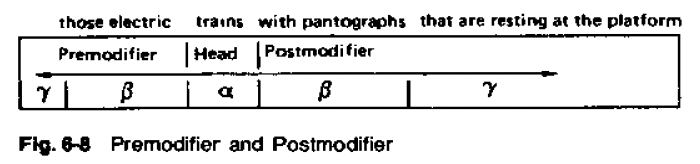
David Rose On 'Ago' And Premodified And Postmodified Adverbial Groups

By ‘surface syntax’ do you mean the syntagm face of our structure-&-syntagm (function-&-class) pairings? If so, Qualifier is realised by an embedded clause or prep phrase, which excludes adverbs like ago. From above, the Qualifier function defines its Thing, probed by which (Thing)?, which also excludes adverbs like ago. This was Pin’s point, not subjectively perceived, but a consistently recurring functional criterion. I think you’re right that we need to be ‘strictly consistent about doubled-up Function-and-Class labelling’

For interest here’s another adv gp analysed in this way... 


IFG also discusses a type of comparative adv gp, that is post-modified with an embedded clause or phrase. It is isn’t named but I’ve used ‘esphoric’ here by analogy with esphoric reference in nom gps, like the children [in blue hats]


Blogger Comments:

[1] This is misleading, because it is untrue. In the nominal group some 4,600 million years ago, the Thing years is characterised by the embedded adverbial group ago. The fact that ago can be premodified demonstrates that ago is the Head of an adverbial group.

[2] This is misleading, because it is untrue. In the nominal group some 4,600 million years ago, the Thing years is characterised by the embedded adverbial group ago rather than the embedded adverbial group hence; that is, the Thing is characterised as 'in the past' rather than 'in the future'. See the examination of Pin Wang's argument here.

[3] This is true.

[4] To be clear, on the model of Halliday (1994), there is no submodification in this adverbial group. So:


That is, Rose proposes internal bracketing, or nesting, where there is none, giving the analysis:
α(β(βα)α)β 
which can be expanded as 
αββ ^ αβα ^ αα ^ β
Rose then compounds the error by misinterpreting the nesting as the double embedding of adverbial groups within the adverbial group, without realising that they must be embedded on this analysis. And, again, on the belief that the adverbial groups are not embedded, incongruously proposes 2-unit complexes (duplexes) consisting of units of different ranks: group and word.

[5] To be clear, 'esphora' is Martin's (1992: 123) rebranding of Halliday & Hasan's (1976) structural cataphora. See The Inconsistencies Created By Rebranding Structural Cataphora As Esphora.

[6] To be clear, on the model of Halliday (1994), there is no submodification in this adverbial group. So:


That is, Rose proposes internal bracketing, or nesting, where there is none, and includes the Postmodifier in the dependency relations, giving the analysis:
β(β(βα)α)α 
which can be expanded as 
βββ ^ ββα ^ βαβ ^ βαα ^ α
Rose again compounds the error by misinterpreting the nesting as the triple embedding of adverbial groups within the adverbial group, without realising that they must be embedded on this analysis. And, again, on the belief that the adverbial groups are not embedded, incongruously proposes 2-unit complexes (duplexes) consisting of units of different ranks: group and word.

And, even in terms of his own approach, Rose has neglected to analyse his final adverbial group so much as the subjacency duplex #βα.

Thursday, 22 February 2024

David Rose Adding Classes To His Analysis Of An Adverbial Group

David Rose wrote to asflanet on 20 Feb 2024, at 20:30:

Adding classes doesn't tell us much more about this adv gp


Blogger Comments:

[1] To be clear, for Halliday (1994: 210), there is no submodification in this adverbial group:
So

As can be seen, the dependency relations all obtain between words.

[2] To be clear, Rose proposes internal bracketing, or nesting, where there is none, giving the analysis:
β(β(β(βα)α)α)α 
which can be expanded as 
ββββ ^ βββα ^ ββαβ ^ ββαα ^ α
Rose then compounds the error by misinterpreting the nesting as the triple embedding of adverbial groups within the adverbial group, without realising that they must be embedded on this analysis. And, on the belief that the adverbial groups are not embedded, incongruously proposes 2-unit complexes (duplexes) consisting of units of different ranks: group and word.

Wednesday, 21 February 2024

David Rose On Focus As Phonology And Jim Martin's Fastidiousness

David Rose replied to Rob Spence on asflanet on 20 Feb 2024, at 12:31:
I think you’ll find the term ‘focus’ is used in phonology for the name of a system information focus, whose features are realised by relations between the Tonic function and lexicogrammar. (More hill than ditch ;-) Focus isn’t used as a function term.
I think you’ll also find that Jim has always been fastidiously careful about distinguishing terms between strata, which I guess he learnt from Michael (all those years ago), and has been teaching others, as the canon has proliferated (all these years since).

He is also fastidiously careful about acknowledging those whose work he and colleagues are building on. How to show respect for others is nicely modelled in current work on register systems, carefully framed in relation to that of Halliday (53 refs), Hasan (42), Carmel Cloran, Cate Poynton and others...


Blogger Comments:

[1] To be clear, INFORMATION is a system of lexicogrammar, not phonology. Halliday & Matthiessen (2014: 115):
… the system of INFORMATION. This is a system not of the clause, but of a separate grammatical unit, the information unit (cf. Halliday, 1967a, 1967/8; Halliday & Greaves, 2008: Section 5.1). The information unit is a unit that is parallel to the clause and the other units belonging to the same rank scale as the clause.

The misunderstanding of INFORMATION as phonology can be sourced to Martin (1992: 384, 401).

[2] This is misleading, because it is untrue. To be clear, 'focus' refers to the lexicogrammatical element of structure that is realised by tonic prominence (Halliday & Matthiessen 2014: 116). Halliday (1992: 371):


[3] This is misleading, because it is untrue. Martin uses the most of the terms from lexicogrammatical cohesion (Halliday & Hasan 1976) in rebranding it as his discourse semantics. Evidence here.

[4] To be clear, Martin (hypocritically) criticises Halliday for 'not distinguishing terms between strata'. Ngo, Hood, Martin, Painter, Smith & Zappavigna (2022: 232):
… confusion invited by the use of grammatical terminology for semantic description in several SFL publications, particularly those dealing with grammatical metaphor (e.g. Halliday and Matthiessen, 1999).

But, in any case, the objection is based on a misunderstanding. A functional grammar interprets grammatical form in terms of its function, which is to realise meaning. In grammatical metaphor, the meaning of a grammatical form is incongruent with the meaning being realised. It is the use of meaning terminology on both strata that enables the systematic description of grammatical metaphor. And, as Halliday & Matthiessen (1999: 237) point out:

Of course, what we are recognising here as two distinct constructions, the semantic and the grammatical, never had or could have had any existence the one prior to the other; they are our analytic representation of the overall semioticising of experience — how experience is construed into meaning. If the congruent form had been the only form of construal, we would probably not have needed to think of semantics and grammar as two separate strata: they would be merely two facets of the content plane, interpreted on the one hand as function and on the other as form.

[5] For the motivation behind this theological term for what in science would be called 'the standard theory', see The Culture Of 'Faith' In The SFL Community.

[6] This misleads through what it omits. It is true that Martin generally acknowledges his sources, though he doesn't always acknowledge that an idea comes from his source rather than himself. Evidence here. But more importantly, having acknowledged his sources, Martin then renames their ideas so that all future references will be to his work and not theirs, thereby giving himself credit for the ideas of others. See for example, here (Martin 1992) and here (Ngo, Hood, Martin, Painter, Smith & Zappavigna 2022).

[7] To be clear, Martin named these scholars because they provided the source of his ideas. Martin then rebranded 'register' as his stratum of context, so all references to register by his readership refer to his model rather than Halliday's original model. Moreover, Martin's model of register is full of self-contradictions. For example, his register is context, not language, despite register being a functional variety of language (cf. beef and dairy cattle not being categorised as 'cattle'); and though it is context, not language, it is instantiated as text, which is language, not context. And this is just the tip of the iceberg.

Monday, 19 February 2024

David Rose On Theory As Theological

Theories are also constellations of icons that adherents affiliate around (thanks Michelle Z and Ken Tann). Basil Bernstein recognised the roots of secular theories in medieval theology, following Durkheim (‘the fundamental categories of science are of religious origin’, 1915:418) and Max Weber (the original ‘legitimation’ theorist). Here’s BB in 2000...
The religious field is constituted by three positions which stand in various relations of complementarity and opposition. In the religious field, we have the prophets, we have the priests, and we have the laity. The rule is that one can only occupy one category at a time. Priests cannot be prophets, and prophets cannot be priests, and the laity cannot be either. There is a natural affinity between prophets and laity, and there is a natural opposition between prophets and priests. These are the lines of opposition structuring the religious field.

If we look at the structure of the pedagogic field, we also have basically three positions that provide analogues to the prophets, priests and laity. The ‘prophets’ are the producers of the knowledge, the ‘priests’ are the recontextualisers or the reproducers, and the ‘laity’ are the acquirers. Thus, we have the structure of the pedagogic field.
Icons like immanence and transcendence are borrowed directly from theological beliefs about the relation of spirit to matter, for which adherents could be excommunicated or worse :-( Bateson’s metatheorising was explicitly theological, rebadging god as ‘mind’ which he believed was immanent in the ‘supreme cybernetic system’. In Lexie’s quote below, he is concerned with the theological question of ‘truth’.* In contrast, Lemke is more interested in the ‘usefulness’ of theories, or as MAKH would call it, ‘appliability’.

* Distinct from philosophical argumentation about truth value of propositions, which is closer to Chris’ yes/no questions of ‘validity’ here.


Blogger Comments:

[1] To be clear, this is sociology: a model of human behaviour. It doesn't distinguish theories (metaphenomena) from favourite football teams, favourite tennis players, favourite pop stars or favourite gurus (phenomena). Nor does it distinguish academics from sports fans, pop music fans or devotees of gurus. That is, it is a model of behaviour with no regard for the intellect and reasoning behind the behaviour.

[2] Synonyms of 'adherent' include:
follower, supporter, upholder, defender, advocate, disciple, votary, partisan, friend, member, stalwart, fanatic, zealot, believer, worshipper, attender, fan, admirer, enthusiast, devotee, lover, addict, aficionado, hanger-on, groupie, buff, freak, fiend, nut, maniac, booster, cohort, rooter, janissary, sectary

[3] To be clear, not theology and not mediæval. Not theology, because theology is the study of religious belief from a religious perspective. Not mediæval, because, as the comparative mythologist Joseph Campbell points out, science fulfils the cosmological function of mythology, and because mythology involves the use of lexical metaphor to reconstrue meaning construed of experience, this dates back to the beginning of metaphor which, according to Halliday was made possible by the stratification of the content plane, which he claims turned Homo … into Homo sapiens (Halliday & Matthiessen 2014: 25).

[4] To be clear, this a sociological model of the social structure of a pedagogic field. That is, it is a model of teachers and teaching, not of the semiotic process of theorising.

[5] To be clear, from an epistemological perspective, 'immanence' and 'transcendence' are orientations to meaning in Western thinking. Halliday & Matthiessen (1999: 415, 416):

We can identify two main traditions in Western thinking about meaning (see Halliday, 1977):
(i) one oriented towards logic and philosophy, with language seen as a system of rules;

(ii) one oriented towards rhetoric and ethnography, with language seen as resource. …
The two orientations towards meaning thus differ externally in what disciplines they recognise as models. These external differences are associated with internal differences as well.

(i) First, the orientations differ with respect to where they locate meaning in relation to the stratal interpretation of language:
(a) intra-stratal: meaning is seen as immanent — something that is constructed in, and so is part of, language itself. The immanent interpretation of meaning is characteristic of the rhetorical-ethnographic orientation, including our own approach.

(b) extra-stratal: meaning is seen as transcendent — something that lies outside the limits of language. The transcendent interpretation of meaning is characteristic of the logico-philosophical orientation.

[6] Rose's interpretation of Bateson is rejected by an expert on Bateson's work. See here. 

[7] To be clear, Ptolemy's Earth-centred model of the known Universe in terms of epicycles was appliable but invalid. Copernicus's Sun-centred model was less appliable, but more valid. Appliability is no guarantee of theoretical validity.

The astronomical predictions of Ptolemy's geocentric model, developed in the 2nd century CE, served as the basis for preparing astrological and astronomical charts for over 1,500 years. The geocentric model held sway into the early modern age, but from the late 16th century onward, it was gradually superseded by the heliocentric model of Copernicus (1473–1543), Galileo (1564–1642), and Kepler (1571–1630). There was much resistance to the transition between these two theories. Some felt that a new, unknown theory could not subvert an accepted consensus for geocentrism.

[8] This is very misleading indeed. On the one hand, the truth value of propositions is the concern of the logico-philosophical tradition, not the rhetorical-ethnographic tradition in which SFL is located. On the other hand, validity is not simply a question of whether propositions are true or false. Validity is a matter of whether conclusions follow from premises. For example,

Given these epistemological assumptions, is this theory valid?
Given this theoretical model, is this application of the theory valid? 

∞

See also The Culture Of 'Faith' In The SFL Community.