
Saturday 27 April 2024


Sunday 21 April 2024
David Rose On Adverbial Group Agnation
David Rose wrote to asflanet on 16 Apr 2024, 20:00:

agnation for the consumer
... as subtypes of intensificationThe nominal realisation is downranked and metaphorical (as with [in the past]). Like congruent adverbial realisations, it can be further intensified and combine with polarity and comparison (but not identically).
Blogger Comments:
[1] To be clear, this is part of Rose's argument that 4.5 billion years ago is an adverbial group. Here he claims that it is agnate with the adverbial group long ago, in that the two are related through the adverbial group system of intensification. There are two problems with this claim.
First, intensification is not a system of the adverbial group, so the two variants are not systemically related through intensification. Instead, 'intensification' describes a type of adverb serving as a Premodifier. Clearly, an embedded nominal group is not a type of adverb. Halliday & Matthiessen (2014: 420-1):
The items serving as Premodifiers are adverbs belonging to one of three types – polarity (not), comparison (more, less; as, so) and intensification. … Those of intensification indicate higher or lower intensity; they are either general intensifiers that are interpersonally neutral (very, much, quite, really, completely, totally, utterly; rather, fairly, pretty; almost, nearly), including the interrogative adverb how, or specific ones that derive from some interpersonally significant scale (amazingly, astonishingly, awfully, desperately, eminently, extraordinarily, horribly, incredibly, perfectly, terribly, terrifically, unbelievably, wonderfully).
Second, if the nominal group 4.5 billion years is interpreted as premodifying ago, then it specifies the temporal extent of ago, not its intensification.
Instead, 4.5 billion years [ago] is a nominal group that is agnate with the nominal group 4.5 billion years [in the past], since they differ only in how a feature of the QUALIFICATION system is realised: as an embedded adverbial group (ago) or an embedded prepositional phrase (in the past). Matthiessen (1995: 669):

On the basis of Matthiessen's network, the feature they both realise is enhancing qualification: time: past.
[2] To be clear, in the case of the two nominal groups, 4.5 billion km away and 4.5 billion years ago, the Qualifiers away and ago are embedded adverbial groups, not ranking adverbs (as Rose would have it). This can be shown by the potential for modification:
- 4.5 billion km further away [than that]
- 4.5 billion years longer ago [than that]
[3] As demonstrated above, it is the adverbial group ago that downranked like the prepositional phrase in the past, not 4.5 billion years.
[4] To be clear, this potential is available to nominal groups:
not so very many years [as that]
Saturday 20 April 2024
David Rose On Focus Structures

The argument in IFG 6.2.5 is elegantly designed to explain nom gps with two Heads, ‘a phenomenon that from one point of view appears as a single entity and from another point of view as two’.It begins by positing a dual experiential/logical structure at group rank, in order to then posit a post-modifier function in the logical structure, in which the experiential Thing is embedded in the Complement of a downranked prep phrase. This model is then applied to a series of nom gp structures, culminating with this one.What if we were to argue instead from this example backwards? As facet is just one of the semantic options for this type of structure (richly captured in IFG Table 6-11), we could generalise its function name, e.g. as Focus. While the Deictic and Thing in this nom gp are realised by words, the Focus is realised by a downranked nom gp, that is linked to the hills by the structure marker ‘of’, whose function we could label LK for Linker.As the Thing in the Focus nom gp is downranked, do we need an additional logical structure in which the primary Thing is downranked?Working backwards, similar structures are analogous with this one, such as those classified as Classifier/Head in IFG.Or Epithet/HeadThis last one is ‘a more restricted type’ which seems to have evolved as an idiomatic realisation of attitude, on the model of the more common Focus structures.
Blogger Comments:
[1] This is misleading because it is not true. To be clear, a nominal group has only one logical Head. Rose's misunderstanding is resolved by the part of the quote he omitted. Halliday & Matthiessen (2014: 396):
In all such nominal expressions where Head and Thing are not conflated although both are clearly present, what is being construed is a phenomenon that from one point of view appears as a single entity and from another point of view as two.
[2] This is misleading because it is not true. To be clear, the experiential Thing is not embedded. It is the nominal group serving as Facet that is embedded in the experiential analysis. The Thing in the experiential structure conflates with the Head of an embedded nominal group in the logical structure.
[3] To be clear, this merely describes the general function of the Extended Numerative in Halliday & Matthiessen (2014: 395), with Matthiessen's 'Extended Numerative' rebranded as Martin's 'Focus'.
[4] To be clear, this creates a theoretical inconsistency, since 'linker' is a class of conjunction that marks a paratactic relation, whereas of is not a conjunction and does not mark a paratactic relation.
[5] To be clear, there is no Thing function in the logical structure of a nominal group. Moreover, the logical structure is necessary in such instances to show that the Head and Thing are dissociated.
[6] To be clear, these analyses fail to (i) recognise the dissociation of Head and Thing, (ii) distinguish between Classifier and Epithet, and (iii) distinguish these structures from Extended Numeratives. As such, they have reduced explanatory power, and can be discarded on that basis.
[7] This is a bare assertion since it is unsupported by evidence: the logical fallacy known as ipse dixit.
Friday 19 April 2024
David Rose On Symmetrical And Transitive Relations

Later in the chapter, Michael reveals that he is indeed talking to knowers of formal logic...‘The relations of projection and expansion, which (when combined with parataxis and hypotaxis) constitute the ‘logical’ component of a natural language, are not reducible to elementary logical relations of a non-linguistic kind...’ (p460)His use of symmetrical and transitive is indeed taken from formal logic...A symmetric relation is a type of binary relation. An example is the relation "is equal to", because if a = b is true then b = a is also true.Transitive relation, a binary relation in which if A is related to B and B is related to C, then A is related to C.This usage is not explained, although the discussion is hard to understand without knowing it. Which makes things a little confusing for us benighted non-knowers.
So Christian may like to adjust or explain this table and discussion for IFG5. While status and sequence are SFL categories, the use of symmetry and transitivity here are not.
This is pretty significant, as these terms are used to define parataxis and hypotaxis on p452, and a series of caveats on p460. Eg, ‘although each implies the other, they are not identical in meaning, because while parataxis is a symmetrical relationship, expansion is not’. Which is why I suggested to Jing thatMy friend, John, ≠ John, my friend, ...(in my ignorance)
Blogger Comments:
[1] This is misleading because it is not true. The Halliday quote merely points out to the linguist reader that the logical relations of natural language are not reducible to the logical relations of designed systems.
[2] This is misleading because it is not true. This usage has been explained in all four editions of IFG. For example, Halliday & Matthiessen (2014: 452):
In principle, the paratactic relation is logically (i) symmetrical and (ii) transitive. This can be exemplified with the ‘and’ relation. (i) ‘salt and pepper’ implies ‘pepper and salt’, so the relationship is symmetrical; (ii) ‘salt and pepper’, ‘pepper and mustard’ together imply ‘salt and mustard’, so the relationship is transitive.
[3] This is misleading because it is not true. All four terms are used as properties of taxis in SFL Theory, as the table makes clear.
[4] To be clear, Rose had argued that the two were not equal on the basis of parataxis:
The thing about parataxis is it’s not reversible (realised by sequence), whereas hypotaxis is reversible (realised by status). So these two aren’t equivalent...My friend John, ≠ John, my friend
but, as his Halliday quote explains, the asymmetry is in the expansion relation, elaboration, not in the paratactic relation.
Thursday 18 April 2024
David Rose On Nominal Group Structure

here are some of the examples from your nom gp table described as Focus structures. From above the types of Focus are semantic categories (class/part/facet/group), from around they are compared with agnate examples, from below they are all linked by the structure marker ‘of’.class (+/- attitude)[my hero] of a friend[my kind] of a friend[that genius] of a student[that type] of a studentpart[the city] of Rome[the suburbs] of Romefacet (abstract)[the concept] of friendship[the reality] of friendshipMy own preference for this analysis is its simplicity, compared with a double experiential/logical analysis with moveable Head. My students also find it relatively simple. Their main difficulty is distinguishing ‘of’ as structure marker of Focus, from ‘of’ as preposition in Qualifier.
Blogger Comments:
[1] Halliday & Matthiessen (2014: 394):

[2] To be clear, the experiential function that Martin merely rebrands with the textual term 'Focus' was previously described as
- Pre-Deictic and Pre-Numerative in Halliday (1985, 1994),
- Facet in Matthiessen (1995), and
- Extended Numerative in Halliday & Matthiessen (2004, 2014).
[3] To be clear, 'part' is a relation of extension, whereas the relation here is elaboration.
[4] To be clear, the 'Focus' analysis is an experiential analysis. It doesn't dispense with the need for a logical analysis. On the contrary, the analysis only arises from comparing the experiential and logical functions.
[5] To be clear, the logical Head does not move. In the above examples, it is always served by the word that precedes the structure marker of. What varies here is the experiential function that conflates with the logical Head.
[6] Trivially, of is both a structure marker and preposition in both cases.
Wednesday 17 April 2024
David Rose On Parataxis

The thing about parataxis is it’s not reversible (realised by sequence), whereas hypotaxis is reversible (realised by status). So these two aren’t equivalent...My friend John, ≠ John, my friend
Funnily enough I was thinking of another line from the same tea partythey cried out when they saw Alice coming...which is hypotactic and reversible (though not logically symmetrical). In contrast,they saw Alice coming and then they cried out...is paratactic and not reversible (which is what I meant).
Blogger Comments:
[1] This misunderstands the distinction between parataxis and hypotaxis. Because parataxis is symmetrical, my friend, John does imply John, my friend. Halliday & Matthiessen (2014: 452):
Parataxis is the linking of elements of equal status…. Both the initiating and the continuing elements are free, in the sense that each could stand as a functioning whole. In principle, the paratactic relation is logically (i) symmetrical and (ii) transitive. This can be exemplified with the ‘and’ relation. (i) ‘salt and pepper’ implies ‘pepper and salt’, so the relationship is symmetrical; (ii) ‘salt and pepper’, ‘pepper and mustard’ together imply ‘salt and mustard’, so the relationship is transitive.
Hypotaxis is the binding of elements of unequal status… . The dominant element is free, but the dependent element is not. The hypotactic relation is logically (i) non-symmetrical and (ii) non-transitive. For example, ‘whe n’: (i) ‘I breathe when I sleep’ does not imply ‘I sleep when I breathe’; (ii) ‘I fret when I have to drive slowly’ and ‘I have to drive slowly when it’s been raining’ together do not imply ‘I fret when it’s been raining’.
[2] To be clear, in terms of parataxis, they saw Alice coming and they cried out imply they cried out and they saw Alice coming. It is the introduction of the logico-semantic relation of time (then) that backgrounds this paratactic symmetry.
[3] To be clear, this cannot be what Rose originally meant, since there was no temporal relation in his original example of parataxis my friend, John.
Tuesday 16 April 2024
David Rose On Qualifiers
and again at 12:45:Qualifiers specify a Thing, so the semantic probe (from ‘above’) is which or whose Thing?Which year?The year [1920]Which city?The city [of Rome]
Focus attends to some aspect of the Thing – a facet, part, class or group. The Thing doesn't specify the Focus. Focus is realised by an embedded nom gp, usually linked to the nom gp by the structure marker ‘of’.[green leaves of] the trees, [some historic buildings of] RomeQualifier is realised by an embedded clause or prep phraseIn The city [of Rome], ‘of’ is a preposition, specifying which city.
Blogger Comments:
[1] To be clear, the Deictic, Numerative, Epithet, Classifier all serve to characterise the Thing (Halliday & Matthiessen 2014: 382), so the probe 'Which Thing?' does not uniquely identify a Qualifier. For example,
- which year? this year: Deictic
- which year? the third year: Numerative
- which year? a good year: Epithet
- which year? a leap year: Classifier
Likewise
- which city? her city: Deictic
- which city? the next city: Numerative
- which city? a polluted city: Epithet
- which city? the eternal city: Classifier
[2] To be clear, 'Focus' is Martin's use of a textual concept to rebrand embedded experiential elements preceding the Thing in a nominal group.
[3] This should go without saying, since it is the Thing that is characterised in a nominal group.
[4] To be clear, these are simply nominal groups with Qualifiers:
- green leaves [of the trees]
- some historic buildings [of Rome]
[of the trees] qualifies leaves in terms of type, [of Rome] qualifies buildings in terms of location.
[5] Trivially, Qualifier is also realised by an embedded adverbial group, as in
- some 4,000 million years [ago]
[6] Clearly, the structure-marking preposition of does not specify which city:
- which city? of.
Friday 12 April 2024
David Kellogg On Non-Defining Relative Clauses

a) She tore up the letter, which upset me (because it was from someone I once loved).b) She tore up the letter which upset me (because it was from someone who was blackmailing me.)In b) the clause is indubitably rankshifted: it's a post-modifying qualifier in a nominal group--no different from "of England" in "the King of England's crown".But why can't I consider the clause in a) to be a Circumstance of "She tore up" or some way of complexing the verbal group in the main clause? Why do I have to consider it a ranking clause in its own right?
I don't get why you are changing the subject, though. The question is about rank, The issue is whether the clause is part of a nominal group or part of a verb complex or (the standard interpretation) a clause complex. …
I do not analyse the instance as a verbal group complex. In truth, I don't see any ambiguity whatsoever: one is a nominal group complex and the other is a hypotactic clause.
If, however, I were applying Merge (or "subjacency"), I would have to argue that "which" is a merged conjunction and pronoun, and therefore the sentence is agnate to "She tore up the letter and upset me", which is a verbal group complex. One more reason for preferring the SFL account.
Blogger Comments:
[1] To be clear, in SFL Theory, (a) is a hypotactic clause complex in which the elaborating dependent clause is a non-defining relative clause:

The fact that the relative clause is ranking, and not a constituent of the primary clause is demonstrated by the fact that, unlike true constituents, it cannot be made Theme of that clause.
[2] To be clear, in SFL Theory, (b) is a single clause in which the Qualifier of a nominal group is a defining relative clause, shifted to word rank:

[3] To be clear, the elaborating relative clause cannot serve as a clause circumstance because it is not a clause constituent — it cannot be thematised — and it does not serve as a Role, the only type of elaborating circumstance.

When confronted with the problems facing his 'circumstance' analysis, Kellogg falsely accused CLÉiRIGh of changing the subject (see here), and at the same time, without acknowledging the fact, moved the goalposts (a logical fallacy) so his claim now became that the relative clause is part of a nominal group, The problem here is that it treats a non-defining relative clause the same as a defining relative clause:


The problem here is that complexing is only possible with units of the same rank, and in hypotactic nominal group complexes, this means with adverbial groups or prepositional phrases. Halliday & Matthiessen (2014: 564):
While the dominant element has to be a nominal group, dependent elements can be adverbial groups or prepositional phrases.
[4] To be clear, after twice proposing a verbal group complex as a possible analysis, Kellogg owns that this is not his analysis. He then goes on to claim that She tore up the letter and upset me features a verbal group complex. However, in SFL Theory, a verbal group complex serves a single Process. In this instance, there are two distinct Processes, one material and one mental, so it is a clause complex, not a verbal group complex:


Monday 1 April 2024
David Rose On Institutional Marginalisation And Comparing Theories
After ChRIS CLÉiRIGh replied to David Rose on asflanet on 25 Mar 2024, at 15:34:
So when it comes down to choosing between theories, say, Newton's or Einstein's construal of gravity, it comes down to feelings: which one the community feels happier with. Perhaps a more appropriate example would be a fundamentalist religious community choosing between Natural Selection and Creationism, on the basis of which one they feel happier with.

An example closer to home might be the persistent marginalisation of SFL in international linguistics. The people ignoring or locking it out of courses and departments all have PhDs in linguistic reasoning.Couldn’t resist sharing this re comparing theories...‘There is a distinct difference between having an open mind and having a hole in your head from which your brain leaks out’.
Blogger Comments:
[1] To be clear, here Rose is invoking the siege mentality of his faith community. From The Culture Of Strong Social Cohesion In The SFL Community at What Lies Beneath:
The origin of strong social bonds within the SFL community can be traced back to the early general exclusion of SFL Theory from linguistic departments and linguistic publications, due to the once overwhelming popularity of Chomskyan Formal Linguistics.This helped to induce a general 'siege mentality' in the early SFL community: a collective state of mind in which a group of people believe themselves constantly attacked, oppressed, or isolated in the face of the negative intentions of the rest of the world, among the consequences of which are social conformity, and a strong sense of social cohesion.This strong sense of social cohesion has remained ever since, despite SFL Theory becoming less excluded from linguistic departments and linguistic publications.One intellectually debilitating consequence of a culture of strong social cohesion is the increased likelihood of 'groupthink'. Groupthink is a phenomenon that occurs when the desire for group consensus overrides people's common sense desire to present alternatives, critique a position, or express an unpopular opinion. Here, the desire for group cohesion effectively drives out good decision-making and problem solving.
From The Tactics Of The Disciplinarian Head Of The Martin Faith Fellowship at What Lies Beneath:
The way Martin constructs a socially bonded community around him is to invoke a 'siege mentality', both with regard to the SFL community in relation to the rest of the linguistic community, and with regard to his own community in relation to the rest of the SFL community.
[2] To be clear, this implies that SFL academics, unlike other linguists, do not have PhDs in linguistic reasoning.
[3] To be clear, here Rose unwittingly presents a 2005 quote from the opponent of pseudoscience, the late James Randi, as if it supports Rose's anti-intellectualism rather than condemns it. The same point had been made previously by his friend, Richard Dawkins, in a public lecture in 1996:
By all means let's be open-minded, but not so open-minded that our brains drop out
and similar wordings have been attributed to Carl Sagan and Groucho Marx.
Sunday 31 March 2024
David Rose On Feelings As The Basis Of Choosing Between Theories
So theorising is more about affiliation; less about relative explanatory potential and valid reasoning, and more about being bound together as a community by the interpretations of the theory produced by the community. And these interpretations serve as icons that the community can rally around and should celebrate.

David Rose replied on asflanet on 25 Mar 2024, at 14:31:
I don't believe those theoretical ideals can be excised from the embodied consciousness that produces them, as Edelman teaches us and you wrote about so brilliantly all those years ago, in terms of homeostasis. No matter how loftily we ideationalise our criteria for validity, it still comes down to feelings. Perhaps the loftier the criteria, the more feelings we invest.
Blogger Comments:
[1] To be be clear, the false assumption here is that assessing the explanatory potential and validity of theories would require excising them from consciousness, whereas it is consciousness that interpersonally enacts the propositions of theory, and consciousness that interpersonally assesses them for explanatory potential and validity.
[2] To be clear, for Rose, choosing between theories, say, Newton's or Einstein's construal of gravity, comes down to feelings: which one the community feels happier with, without regard for explanatory potential or validity. This is analogous to a fundamentalist religious community preferring Creationism to Natural Selection because they feel happier with it. Again, see The Culture Of 'Faith' In The SFL Community at What Lies Beneath
Saturday 30 March 2024
David Rose On Interpreting, Extending And Enhancing Theory

Yes, the question’s not about grammar is it? It’s about metalanguage, so the explanation is necessarily at the stratum of register. And it’s not just a question about the theory, and its uses in analyses, applications, publishing and teaching, but about the community of users that we’re privileged to belong to. It’s about belonging and authority... who has the authority to interpret, extend or enhance the theory and its applications, whose analyses should be celebrated by the community, who’s inside. The simple answer is all of us. We all belong to the community, and we all draw our repertoires from its reservoir of appliable theory. We’re all guided by each other. The answers I’ve given are the best I can do, so thanks for asking the questions.“Aunty,” Jem spoke up, “Atticus says you can choose your friends but you sho’ can’t choose your family, an’ they’re still kin to you no matter whether you acknowledge ’em or not, and it makes you look right silly when you don’t.”
Blogger Comments:
[1] To be clear, Rose had been asked about the explanatory advantage of one grammatical analysis over another. This he could not answer.
[2] To be clear, for Rose, theorising is about belonging and authority. From The Culture Of 'Faith' In The SFL Community at What Lies Beneath:
Its intellectual challenges and contrary methodology make SFL Theory and its argumentation comparatively difficult to understand. This creates a culture in the SFL community where the theory is less understood than taken on trust, like religious faith.In a faith community, a doctrine is held as a revelation to be believed, rather than a theory to be in/validated by reasoned argumentation. In such a community, experts are providers or interpreters of revelations, rather than experts in reasoned argumentation, and in matters of interpretation, it is such individuals that are criterial, rather than reasoned argumentation. With individuals as criterial in doctrine interpretation, communities form around those individuals.
[3] To be clear, for Rose, every member of the community has authority in matters of theory, interpretation and analysis. From The Promotion Of Anti-Intellectualism In The SFL Community at What Lies Beneath:
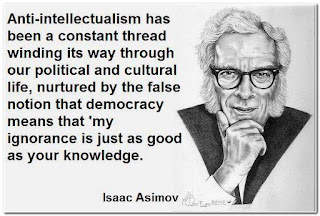
One consequence of not realising that Systemic Functional Linguistic Theory is a scientific theory is the belief that work in the theory does not have to be consistent with the theory. The extreme version of this is the belief that all theoretical opinions are valid, and this view is sometimes defended as open-minded fairness.However, just as work in other scientific theories — such as Quantum Theory or the General Theory of Relativity — has to be consistent with a valid theory to be valid, so too does work in SFL Theory.Isaac Asimov has explained this form of anti-intellectualism as a misapplication of the notion of 'democracy':
Friday 29 March 2024
David Rose Differentiating Grammatical Structures By Field, Mode And Tenor
I’d kinda hoped it was obvious, a linguistic double entendreBut OK, it’s a pleasant Sunday morning exercise that someone may find useful, evaluating field, mode, tenorThe full arguments are in...Martin, J. R., & Doran, Y. J. (2023). Structure markers: A subjacency duplex analysis. Language, Context and Text, 5(1), 16-48.
This nom gp is ambiguous, with two different experiential interpretations. I offered three analyses...1. Whose king’s hat? – counterexpectant interpretationF: a traditional multivariate Hallidayan analysis of nom gp functions, but with all realising syntagms accounted for, using subj dupl labels, and possessive suffixes explicitly labelled as non-recursive #bM: clearly displays each structure:syntagm cycle at each rankT: authority of a ‘standard analysis’ plus, and it’s counterexpectantly funnier2. Whose king’s hat?F: a re-analysis of nom gp classifying function, as recursive subclassification at word rank, rather than multivariate group functions (Classifier Thing)M: displays complementarity of subjacent and hypotactic word rank structuresT: more radical, but interesting, potentially inspiring further research3. Whose hat? – expectant interpretationF: more accurate than a ‘gamma beta alpha’ analysis, because this isn’t a hypotactic series. The Deictic is realised by an embedded nom gp [England’s king], which itself has a Deictic Thing structureM: explicit syntagm labelling reveals this structuringT: not as funny
Blogger Comments:
[1] To be clear, field, mode and tenor do not distinguish these three analyses, because each analysis is in the same text of the same situation.
- The field is what's going on in the situation: linguistic analysis
- The mode is the role of language in the situation: dialogue on an email discussion list
- The tenor is who's taking part in the situation: linguists
None of Rose's "evaluations" bears the slightest resemblance to the field, mode and tenor of the situation of this text. See The Practice Of Public Bluffing In The SFL Community at What Lies Beneath.
[2] This is misleading because Martin & Doran (2023) does not provide any "full arguments" with respect to Rose's analyses. This can be verified by reading the review of Martin & Doran (2023):
Thursday 28 March 2024
David Rose On Three King's Hats

That was the joke... whose hat? – England’s king’s, or whose king’s hat? – England’sNow I have to explain the punchline ;-/In both interpretations, group and word rank can be analysed in a single displayWhose king’s hat?
a and #b are symbols for Head and Modifier, so no need to restate. The hash # means non-recursive (only one ‘s). So subjacent duplexes rather than hypotactic series.The other interpretation is more structurally complex. It isn’t a hypotactic series because the Deictic is realised by an embedded nom gp [England’s king], which itself has a Deictic Thing structure.Whose hat?
I should add an alternative analysis for whose king’s hat? that treats subclassification of the Thing as a potentially recursive word complex (after Martin, Doran, Zhang). Here’s king’s subclassifies hat. The Thing is not just a hat, it’s a king’s hat.
Blogger Comments:
[1] To be clear, the original contrast was between the king of England's hat and England's king's hat. Here Rose has "moved the goalposts" to two interpretations of England's king's hat.
[2] To be clear, this analysis assumes there is a type of hat called a 'king's hat'. What is labelled 'subjacency duplex' is, in each case, a word consisting of a stem and a suffix. The analysis mislabels the stem morpheme as a word (name, noun).

[3] This is a serious misunderstanding. Even a two-unit complex, a duplex, is generated by a recursive system. In a two-unit complex, the feature 'stop' is selected on the first pass through the system. That is, the system is recursive, but the option of re-entering the system is not taken in this case. But this is, in any case, irrelevant here, since the logical structure of this nominal group is a triplex, not a duplex.
[4] To be clear, it is a hypotactic series because the logical structure of the nominal group is a triplex.

[5] To be clear, the Deictic is not realised by the embedded nominal group [England's king]. It is realised by the two nouns England's and king's which, not being a nominal group, do not have a Deictic^Thing structure.
[6] As in the first analysis, what is labelled 'subjacency duplex' is, in each case, a word consisting of a stem and a suffix. The analysis mislabels the stem morpheme as a word (name, noun). A logical analysis clarifies the nominal group structure.

Wednesday 27 March 2024
David Rose Applying Subjacency Duplexes To An English Sovereign
Blogger Comments:
[1] In the first example, Rose's subjacency duplex analysis conflates group rank with word rank. To be clear, the nominal group the King of England serves the same function as George in George's hat, where George and 's are two morphemes that constitute the word George's. That is, the nominal group the King of England is shifted to morpheme rank, as a constituent of the King of England's.

[2] In the second example, Rose's analysis assumes that king's is a type of hat. The words that realise the Deictic and Classifier are then interpreted as subjacency duplexes instead of the Head and Modifier morphemes of a noun. Assuming, more reasonably, that the hat belongs to the king of England, the analysis is:

Tuesday 26 March 2024
David Rose On Halliday's Instantiation/Stratification Matrix

This matrix from a talk MAKH gave to computer scientists in 95 may help to flesh out the SFL timeline a little.
It is based on ideas he first proposed in 1961. Subsequent research was overwhelmingly in the bottom row – on LG systems. Cells above that are proposals for research. He comments “Semantic representations of the instance — the instance as meaning — are still quite unsatisfactory, and there is much work to be done in this respect. Likewise for the instantial situation: we tend to work with informal word-pictures, like the stage directions in the printed edition of a play; but the basic concept of situation as instance has advanced very little in recent decades” (2005:255).The upper and middle left-hand cells were the focus of Jim Martin and colleagues’ research through the 80s, culminating in English Text in 92. Metafunctional semantic systems were described as discourse semantics. Systems were also described for ‘potential clusterings of values of field, tenor, mode’, that were named genre systems. Appliability was one motivation for prioritising genre systems. Systems were proposed for field, tenor, mode, but it took another two decades for this research to be taken up in earnest, starting with Jing Hao on field, followed by a series of studies, culminating in Doran, Martin, Herrington 2023 (and Yaegan’s recent course at Usyd).A crucial advance in this research is description of field, tenor, mode systems as semiotic systems that are instantiated, not by ‘informal word-pictures’, but by ‘selection expressions’, as the matrix specifies for LG and semantic systems.Another major step forward is the reconstrual of what MAKH calls ‘values’ in the top row as ‘principles’ of instantiation, and ‘domains’ of individuation. This potentially integrates research using different SFL models into a commensurate whole.It also helps resolve an anomaly in the upper right-hand cell, in which instances of socio-semiotic systems are named ‘particular social semiotic situation events’, whereas instances of LG and semantic systems are simply named ‘particular texts’. A social semiotic event is of course a (multimodal) text."The left-hand upper cell is taken up with contextual networks: it contains a theory of the possible semiotic situations that collectively constitute a culture – taxonomies of institutions and of doings and happenings, manifested as possible clusterings of values of field, tenor and mode.” Halliday 2005: 255
Blogger Comments:
[1] This is misleading because it is untrue. Scale & Category Grammar (Halliday 1961) did not include a cline of instantiation, nor Malinowski's notions of context, nor a semantic stratum:

[2] To be clear, it is important to recognise that Halliday himself never proposed system networks to represent the systems of context.
[3] This is misleading. Martin (1992) rebranded the lexicogrammatical systems of the textual metafunction in Halliday & Hasan (1976) as his discourse semantic systems and distributed them across the different metafunctions. To these systems he added Halliday's semantic system of speech function and rebranded it as his discourse semantic system of negotiation.
[4] To be clear, Martin (1992) mistook registers for the contextual systems (field, tenor, mode) that are realised by registers, thereby proposing that a functional variety of language was not language, but context. Martin (1992) then confused two meanings of 'genre', genre as mode and genre as text type, and located the confusion stratally above register in context. This had the effect of proposing that text types were realised by field, tenor, and mode, instead of the reverse, thereby upending the realisation relation.
[5] To be clear, Hao and Doran were Martin's students and use Martin's model that proposes that functional varieties of language are not language, but context.
[6] This is cleverly misleading. First, Halliday did not describe field, tenor and mode as instantiated by 'informal word pictures'. Halliday used 'informal word pictures' to describe instances of field, tenor and mode, because he didn't have formal systems of field, tenor and mode to model the potential. Second, in Martin's model, context is realised by an instance of language, text, whereas this advance by Doran, Martin & Herrington (2024) rejects Martin's model, so that context systems are now instantiated by context, not by language (text).
[7] This is misleading, because this major step forward is major step backward. Doran, Martin & Herrington (2024) have reinterpreted the features of field, tenor and mode systems as 'principles of instantiation' in order to make room for semantic systems which they misconstrue as contextual. That is, having first misconstrued language (register) as context, Martin is now, with his colleagues, misconstruing context (field, tenor, mode) as language. See also
- Negotiating Tenor: Enacting Affiliation In Dialogue And Monologue (Yaegan Doran)
- A Close Examination Of Yaegan Doran's 2023 ASFLA Plenary Abstract
[8] For some of the inconsistencies that invalidate Martin's model of individuation, see
- David Rose Endorsing Martin's Misunderstandings Of Individuation
- David Rose On Martin's Context-Bound/Free And Individuation As Allocation/Affiliation
[9] For some of the inconsistencies that invalidate Martin's integrated model, see
[10] This is misleading, because there is no anomaly in the upper right-hand cell, though the false claim betrays a serious misunderstanding of the distinction between context and language. 'Particular social semiotic situation events' describes instances of context: the culture as semiotic potential. A text, on the other hand, is an instance of the content plane of language: semantics and lexicogrammar. A multimodal text includes instances of the content plane of semiotic systems other than language.
Subscribe to:
Posts (Atom)